 |
Books Should Be Free Loyal Books Free Public Domain Audiobooks & eBook Downloads |
|
|
|
Books Should Be Free Loyal Books Free Public Domain Audiobooks & eBook Downloads |
|
Top Authors |
|---|
|
Book type:
Sort by:
|
By: Thornton W. Burgess (1874-1965) | |
|---|---|
 Mother West Wind's Children
“You can’t fool old Mother Nature. No, Sir, you can’t fool old Mother Nature, and it’s of no use to try.” The animals of the Green Meadows and Green Forest have little adventures while Grandfather Frog tells stories to Mother West Wind’s children, the Merry Little Breezes. | |
 The Adventures of Johnny Chuck
The Adventures of Johnny Chuck is another in the long list of children’s books by conservationist Thornton W. Burgess. In this story, it is spring time and a young chuck’s fancy turns to thoughts of … traveling, protecting one’s turf, finding a new home, and yes, love. Along the way, we learn little lessons about life such as there are good and bad kinds of pride, the importance of keeping secrets and that, even in the animal world, the three most important factors in determining the desirability of property are “location, location, location.” | |
 Old Mother West Wind
Thornton Waldo Burgess (January 14, 1874 – June 5, 1965) was a conservationist and author of children’s stories. He loved the beauty of nature and its living creatures so much that he wrote about them for 50 years. By the time he retired, he had written more than 170 books. Many of his outdoor observations in nature were used as plots for his stories. In his first book, “Old Mother West Wind,” published in 1910, the reader meets many of the characters found in later books and stories. These... | |
 Mother West Wind 'Why' Stories
Thornton W. Burgess was a conservationist and prolific author of children’s books. His gently humorous stories about the animals of the meadows and woods teach little lessons about getting along with others; they are perfect bedtime stories for small children. | |
By: Julian Hawthorne, editor | |
|---|---|
 Library of the World's Best Mystery and Detective Stories
The Library of the World's Best Mystery and Detective Stories is a six-volume edition, which contains one hundred and one tales written by authors as diverse and separated by history as Pliny the Younger (first century AD), Voltaire (17th century) and Guy de Maupassant (19th century) and also from different parts of the world. This volume which is the first, contains twenty interesting stories, and an introduction by the editor. The fascinating aspect of mystery stories is that sometimes the author allows the puzzle to solve itself without expert detective aid, while in other cases, a sleuth bends his or her deductive powers to the mystery... | |
By: Jean-Jacques Rousseau (1712-1778) | |
|---|---|
 A Discourse Upon the Origin and the Foundation of the Inequality Among Mankind
This work presents Rousseau’s belief in the profoundly transformational effects of the development of civilization on human nature, which Rousseau claims other political philosophers had failed to grasp. Specifically, before the onset of civilization, according to Rousseau, natural man lived a contented, solitary life, naturally good and happy. It is only with the onset of civilization, Rousseau claims, that humans become social beings, and, concomitant with their civilization, natural man becomes corrupted with the social vices of pride, vanity, greed and servility. | |
 The Social Contract
The Social Contract outlines Rousseau’s views on political justice, explaining how a just and legitimate state is to be founded, organized and administered. Rousseau sets forth, in his characteristically brazen and iconoclastic manner, the case for direct democracy, while simultaneously casting every other form of government as illegitimate and tantamount to slavery. Often hailed as a revolutionary document which sparked the French Revolution, The Social Contract serves both to inculcate dissatisfaction with actually-existing governments and to allow its readers to envision and desire a radically different form of political and social organization. (Summary by Eric Jonas) | |
 Confessions
Considered to mark the emergence of a new literary form, the unvarnished autobiography, Confessions by Jean-Jacques Rousseau was first published in 1782, four years after his death. The philosopher and educationist whose political philosophy is credited with having inspired the French Revolution, Rousseau was a man of immense wit, talent and depth of thinking. His skill in art, music, literature and cooking along with his magnificent body of work in philosophy, politics, education and sociology have made him a legendary figure... | |
 The Confessions of J. J. Rousseau
| |
|
Émile or, Concerning Education; Extracts
| |
By: Abraham Lincoln (1809-1865) | |
|---|---|
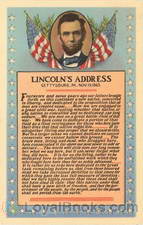 The Gettysburg Address
Lincoln's Gettysburg Address, given November 19, 1863 on the battlefield near Gettysburg, Pennsylvania, USA Four score and seven years ago, our fathers brought forth upon this continent a new nation: conceived in liberty, and dedicated to the proposition that all men are created equal. Now we are engaged in a great civil war. . .testing whether that nation, or any nation so conceived and so dedicated. . . can long endure. We are met on a great battlefield of that war. We have come to dedicate a portion of that field as a final resting place for those who here gave their lives that this nation might live... | |
 Lincoln at Cooper Union
On 27 February 1860, Abraham Lincoln gave this address at the Cooper Union in New York City. When he gave the speech, Lincoln was considered by many to be just a country lawyer. After he gave the speech, he soon became his party’s nominee for president. | |
|
Abraham Lincoln Writings
| |
|
Speeches & Letters of Abraham Lincoln, 1832-1865
| |
|
Abraham Lincoln's Second Inaugural Address
| |
|
Quotes and Images From The Writings of Abraham Lincoln
| |
|
Abraham Lincoln's First Inaugural Address
| |
|
The Writings of Abraham Lincoln — Volume 1: 1832-1843
| |
|
Lincoln Letters
| |
|
The Emancipation Proclamation
| |
|
Lincoln's Inaugurals, Addresses and Letters (Selections)
| |
|
The Writings of Abraham Lincoln — Volume 4 The Lincoln-Douglas debates
| |
|
The Writings of Abraham Lincoln — Volume 3 The Lincoln-Douglas debates
| |
|
State of the Union Address
| |
|
The Life and Public Service of General Zachary Taylor: An Address
| |
By: Aristotle (384-322) | |
|---|---|
 Politics
The Politics, by the ancient Greek philosopher Aristotle, is one of the most influential texts in political philosophy. In it, Aristotle explores the role that the political community should play in developing the virtue of its citizens. One of his central ideas is that “Man is a political animal,” meaning that people can only become virtuous by active participation in the political community. Aristotle also criticizes his teacher Plato, classifies and evaluates six different types of constitutions and political institutions, and describes his vision of the ideal state... | |
 Poetics
Aristotle’s Poetics from the 4th century B.C. aims to give a short study of storytelling. It discusses things like unity of plot, reversal of situation, and character in the context of Greek tragedy, comedy and epic poetry. But it still applies today. It is especially popular with screenwriters as seen in many script gurus’ how-to books. | |
 The Nicomachean Ethics
The work consists of ten books, originally separate scrolls, and is understood to be based on notes said to be from his lectures at the Lyceum which were either edited by or dedicated to Aristotle's son, Nicomachus. In many ways this work parallels the similar Eudemian Ethics, which has only eight books, and the two works can be fruitfully compared. Books V, VI, and VII of the Nicomachean Ethics are identical to Books IV, V, and VI of the Eudemian Ethics. Opinions about the relationship between the two works, for example which was written first, and which originally contained the three common books, is divided... | |
 Rhetoric
The Rhetoric was developed by Aristotle during two periods when he was in Athens, the first between 367 to 347 BCE (when he was seconded to Plato in the Academy), and the second between 335 to 322 BCE (when he was running his own school, the Lyceum). The Rhetoric consists of three books. Book I offers a general overview, presenting the purposes of rhetoric and a working definition; it also offers a detailed discussion of the major contexts and types of rhetoric. Book II discusses in detail the three means of persuasion that an orator must rely on: those grounded in credibility (ethos), in the emotions and psychology of the audience (pathos), and in patterns of reasoning (logos)... | |
 Categories
Categories is the first of Aristotle's six texts on logic which are collectively known as the Organon. In Categories, Aristotle enumerates all the possible kinds of things that can be the subject or the predicate of a proposition. Aristotle places every object of human apprehension under one of ten categories (known to medieval writers as the praedicamenta). Aristotle intended them to enumerate everything that can be expressed without composition or structure, thus anything that can be either the subject or the predicate of a proposition. The ten categories, or classes, are: Substance, Quantity, Quality, Relation, Place, Time, Position, State, Action and Affection. | |
 On Interpretation
Aristotle's On Interpretation (Greek Peri Hermeneias) or De Interpretatione (the Latin title) is the second of Aristotle's six texts on logic which are collectively known as the Organon. On Interpretation is one of the earliest surviving philosophical works in the Western tradition to deal with the relationship between language and logic in a comprehensive, explicit, and formal way. The work begins by analyzing simple categoric propositions, and draws a series of basic conclusions on the routine... | |
 Posterior Analytics
Posterior Analytics is the fourth of Aristotle's six texts on logic which are collectively known as the Organon ("Instrument"). Posterior Analytics deals with demonstration, definition, and scientific knowledge. Demonstration is distinguished as a syllogism productive of scientific knowledge, while Definition is marked as the statement of a thing's nature, a statement of the meaning of the name, or of an equivalent nominal formula. | |