In Praise of Folly Illustrated with Many Curious Cuts By: Desiderius Erasmus (1469-1536) |
|---|
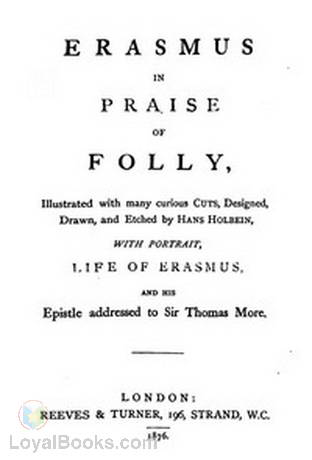
In Praise of Folly Illustrated with Many Curious Cuts by Desiderius Erasmus is a thought-provoking and satirical piece of literature that offers a scathing critique of various societal norms and hierarchical structures present during the Renaissance period. Erasmus masterfully employs wit and clever humor to shed light on the follies of human nature and provides a fresh perspective on numerous aspects of society.
One of the most remarkable features of this book is Erasmus's ingenious use of personification to personify Folly itself as the narrator. Through this unique narrative voice, Erasmus embarks on a fascinating exploration of human weaknesses and vices, questioning the unquestionable and challenging the established order. Folly's witty and occasionally cynical observations offer readers a refreshing take on religion, politics, and the general behavior of individuals.
Furthermore, the inclusion of numerous delightful and meticulously crafted illustrations significantly enhances the reader's experience. These clever depictions not only complement the text but also serve as visual aids that further reinforce the author's humorous arguments. The illustrations effortlessly capture the absurdity and peculiarity of various characters and situations, making them both comical and thought-provoking.
Erasmus's wit and intellect shine throughout this work, showcasing his vast knowledge of classical literature, philosophy, and theology. The author expertly weaves together references to Greek and Roman literature, biblical stories, and philosophical concepts, creating a rich tapestry of allusions that add depth and complexity to his arguments. These intellectual undertones make the book a fascinating read for those interested in the history of ideas.
Although originally written as a critique of the Catholic Church and its clergy, In Praise of Folly goes beyond its initial intentions. It touches upon themes that remain relevant even in our contemporary society, such as the dangers of blindly following tradition, the masks we wear in our public personas, and the constant presence of folly in the pursuit of power and wealth.
While some readers may find Erasmus's writing style challenging due to the use of classical references and the complexity of the ideas presented, this book remains an essential read for those seeking a deeper understanding of human nature and the flaws inherent in society. Erasmus's ability to seamlessly blend satire, intellect, and humor creates a captivating and thought-provoking literary work that stands the test of time.
Overall, In Praise of Folly Illustrated with Many Curious Cuts is an enlightening and entertaining book that offers a valuable critique of society's follies, both personal and collective. Erasmus's talent for blending wit, satire, and philosophical depth makes this book an essential addition to any intellectual's library. IN PRAISE OF FOLLY By Erasmus Illustrated with many curious CUTS, Designed, Drawn, and Etched by Hans Holbein, WITH PORTRAIT, LIFE OF ERASMUS, AND HIS Epistle addressed to Sir Thomas More. LONDON: REEVES & TURNER, 196, STRAND, W.C. 1876. THE LIFE OF ERASMUS. ERASMUS, so deservedly famous for his admirable writings, the vast extent of his learning, his great candour and moderation, and for being one of the chief restorers of the Latin tongue on this side the Alps, was born at Rotterdam, on the 28th of October, in the year 1467. The anonymous author of his life commonly printed with his Colloquies (of the London edition) is pleased to tell us that de anno quo natus est apud Batavos, non constat . And if he himself wrote the life which we find before the Elzevir edition, said to be Erasmo autore , he does not particularly mention the year in which he was born, but places it circa annum 67 supra millesintum quadringentesimum . Another Latin life, which is prefixed to the above mentioned London edition, fixes it in the year 1465; as does his epitaph at Basil. But as the inscription on his statue at Rotterdam, the place of his nativity, may reasonably be supposed the most authentic, we have followed that. His mother was the daughter of a physician at Sevenbergen in Holland, with whom his father contracted an acquaintance, and had correspondence with her on promise of marriage, and was actually contracted to her... Continue reading book >>
|
| This book is in genre |
|---|
| Languages |
| eBook links |
|---|
| Wikipedia – Desiderius Erasmus |
| Wikipedia – In Praise of Folly Illustrated with Many Curious Cuts |
| eBook Downloads | |
|---|---|
|
ePUB eBook • iBooks for iPhone and iPad • Nook • Sony Reader |
Kindle eBook • Mobi file format for Kindle |
|
Read eBook • Load eBook in browser |
Text File eBook • Computers • Windows • Mac |
| Review this book |
|---|
