The Trial of Theodore Parker For the "Misdemeanor" of a Speech in Faneuil Hall against Kidnapping, before the Circuit Court of the United States, at Boston, April 3, 1855, with the Defence By: Theodore Parker (1810-1860) |
|---|
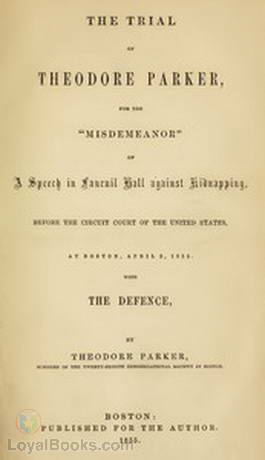
The Trial of Theodore Parker For the "Misdemeanor" of a Speech in Faneuil Hall against Kidnapping, before the Circuit Court of the United States, at Boston, April 3, 1855, with the Defence by Theodore Parker is an important historical document that sheds light on the activism and legal battles surrounding the abolitionist movement in mid-19th century America.
Set in the backdrop of Boston, the book presents the trial proceedings of Theodore Parker, a prominent abolitionist and preacher who was charged with the "misdemeanor" of giving a speech against kidnapping in Faneuil Hall. The trial, held in April 1855, becomes a battleground where Parker passionately defends his right to free speech and challenges the moral legitimacy of slavery.
One of the remarkable aspects of this book is the meticulous documentation of the trial itself. The author, Theodore Parker, provides a detailed account of the courtroom proceedings, including the arguments made by the prosecution and the defense. This allows readers to gain a firsthand understanding of the legal strategies employed by both sides and the issues at stake.
Parker's defense, which forms a significant part of the book, is a powerful and eloquent statement on the fundamental rights of individuals and the evils of slavery. Through logical reasoning, historical references, and impassioned rhetoric, he dismantles the accusations against him and exposes the injustice of the system that seeks to silence abolitionist voices.
Beyond the legal aspects, the book also serves as a significant historical record of the social and political climate of its time. The Trial of Theodore Parker provides valuable insights into the tensions between pro-slavery and anti-slavery factions, as well as the broader public opinion on the issue of slavery. It captures the atmosphere of fear and hostility that permeated the era, where speaking out against the institution of slavery could lead to legal persecution.
What makes this book particularly relevant today is its exploration of themes related to free speech and the limits of dissent in a democratic society. Through Parker's case, readers are forced to confront the questions of whether moral conviction can justify civil disobedience and if the law should be seen as an absolute authority even when it goes against one's deeply held beliefs.
While the book's title is quite lengthy and exact, it accurately reflects the content within its pages. The Trial of Theodore Parker For the "Misdemeanor" of a Speech in Faneuil Hall against Kidnapping, before the Circuit Court of the United States, at Boston, April 3, 1855, with the Defence by Theodore Parker presents a comprehensive account of a significant trial that unfolded in the midst of a tumultuous period in American history. It serves as both a valuable historical record and a thought-provoking exploration of the limitations of justice and free speech. THE TRIAL OF THEODORE PARKER, FOR THE "MISDEMEANOR" OF A Speech in Faneuil Hall against Kidnapping, BEFORE THE CIRCUIT COURT OF THE UNITED STATES, AT BOSTON, APRIL 3, 1855. WITH THE DEFENCE, BY THEODORE PARKER, MINISTER OF THE TWENTY EIGHTH CONGREGATIONAL SOCIETY IN BOSTON. BOSTON: PUBLISHED FOR THE AUTHOR. 1855. Entered according to Act of Congress, in the year 1855, by THEODORE PARKER, In the Clerk's Office of the District Court of the District of Massachusetts. CAMBRIDGE: ALLEN AND FARNHAM, PRINTERS. CONTENTS PREFACE INTRODUCTION DEFENCE ERRATA OTHER WORKS BY THE SAME AUTHOR TO JOHN PARKER HALE AND CHARLES MAYO ELLIS, MAGNANIMOUS LAWYERS, FOR THEIR LABORS IN A NOBLE PROFESSION, WHICH HAVING ONCE IN ENGLAND ITS KELYNG, ITS SAUNDERS, ITS JEFFREYS, AND ITS SCROGGS, AS NOW IN AMERICA ITS SHARKEY, ITS GRIER, ITS CURTIS, AND ITS KANE, HAS YET ALSO SUCH GENEROUS ADVOCATES OF HUMANITY AS EQUAL THE GLORIES OF HOLT AND ERSKINE, OF MACKINTOSH AND ROMILLY, FOR THEIR ELOQUENT AND FEARLESS DEFENCE OF TRUTH, RIGHT, AND LOVE, THIS VOLUME IS DEDICATED, BY THEIR CLIENT AND FRIEND, THEODORE PARKER... Continue reading book >>
|
| eBook Downloads | |
|---|---|
|
ePUB eBook • iBooks for iPhone and iPad • Nook • Sony Reader |
Kindle eBook • Mobi file format for Kindle |
|
Read eBook • Load eBook in browser |
Text File eBook • Computers • Windows • Mac |
| Review this book |
|---|
