 |
Books Should Be Free Loyal Books Free Public Domain Audiobooks & eBook Downloads |
|
|
|
Books Should Be Free Loyal Books Free Public Domain Audiobooks & eBook Downloads |
|
Philosophy Books |
|---|
|
Book type:
Sort by:
View by:
|
By: David Friedrich Strauss (1808-1874) | |
|---|---|
 The Life of Jesus Critically Examined
Strauss was an early pioneer in the ongoing 'Quest of the Historical Jesus' held amongst New Testament scholars, and his Life of Jesus is one of the few landmarks in the field. The first edition of Strauss' book was published in Germany in 1835 when he was only 27 years old, and which by 1840 had gone through four editions. He focused his attention on battling two theological fronts which were current at the time - the traditional Orthodox who believed the miracles in the Gospels were to be taken as literal, yet supernatural, history; and the Rationalists, who believed that the Gospel miracles were all true but could be explained by natural and purely physical causes... | |
By: David Hume (1711-1776) | |
|---|---|
 An Enquiry Concerning Human Understanding
The Enquiry Concerning Human Understanding is a shortened and simplified version of Hume’s masterpiece A Treatise of Human Nature. It sought to reach a wider audience, and to dispel some of the virulent criticism addressed toward the former book. In it, Hume explains his theory of epistemology, and argues against other current theories, including those of John Locke, George Berkeley, and Nicolas Malebranche. | |
 Dialogues Concerning Natural Religion
In Dialogues Concerning Natural Religion, philosopher David Hume examines whether belief in God can be rational. The work takes the form of a debate between three characters: Cleanthes, who argues that the existence and nature of God can be empirically verified; Demea, who argues that God is completely beyond human knowledge; and Philo, a philosophical skeptic widely thought to represent Hume’s own beliefs. Much of the debate centers around Cleanthes’ presentation of the analogical argument from design... | |
 A Treatise Of Human Nature
This book, published in two volumes called “books” by the author, is a treatment of everything from the origin of our ideas to how they are to be divided. It includes important statements of Scepticism and Hume’s experimental method. Part 1 deals with the nature of ideas. Part 2 deals with the ideas of space and time. Part 3 deals with knowledge and probability. Part 4 deals with skeptical and other systems of philosophy, including a discussion of the soul and personal identity.This is a recording of Volume I (or Book 1). Volume II (which contains Books 2 and 3) is in production at the moment. | |
 Enquiry Concerning the Principles of Morals
| |
By: Desiderius Erasmus (1466/69-1536) | |
|---|---|
 The Praise of Folly
The Praise of Folly (Greek title: Morias Enkomion (Μωρίας Εγκώμιον), Latin: Stultitiae Laus, sometimes translated as In Praise of Folly, Dutch title: Lof der Zotheid) is a satirical essay written in 1509 by Desiderius Erasmus of Rotterdam (1466/69-1536). It is considered one of the most influential works of literature in Western civilization and one of the catalysts of the Protestant Reformation.It starts off with a satirical learned encomium after the manner of the Greek satirist... | |
By: Edgar Thurston (1855-1935) | |
|---|---|
 Omens and Superstitions of Southern India
This book deals mainly with some aspects of what may be termed the psychical life of the inhabitants of the Madras Presidency, and the Native States of Travancore and Cochin. | |
By: Edmund Spenser (1552?-1599) | |
|---|---|
|
Amoretti: A sonnet sequence
The Amoretti (meaning little love poems) is a sequence of 89 sonnets written in the tradition of the Petrarchan sonnets, a popular form for poets of the Renaissance period. Spenser’s sequence has been largely neglected in modern times, while those of his contemporaries William Shakespeare and Sir Philip Sidney have been acclaimed. However, because of the artistic skill, along with the emotion and the humor exhibited, these poems deserve a broader hearing, even though they may be somewhat difficult for the present-day reader, partly through Spenser’s love for words and expressions that were already archaic in his time... | |
By: Edna Lyall (1857-1903) | |
|---|---|
 The Autobiography of a Slander
The Autobiography of a Slander exposes the consequences of reckless words or, even worse, intentionally disparaging words. In this moral tale, told from the point of view of "the slander", Edna Lyall (pseudonym used by Ada Ellen Bayley) reveals her ideals and goals in life and relationships. | |
By: Edward Carpenter (1844-1929) | |
|---|---|
|
Pagan & Christian Creeds: Their Origin and Meaning
In this work from 1921, Carpenter analyzes the origin of Christian beliefs, arguing that they are derived from pre-Christian myths and religions, rather than being new revelations to the human race. He believes that “psychologically man has evolved from simple consciousness to self-consciousness, and is now in process of evolution towards another and more extended kind of consciousness,” anticipating a post-Christian era. In the penultimate chapter, “The Exodus of Christianity,” he sets out his belief that for Christianity “to hold the field of Religion in the Western World is neither probable nor desirable... | |
By: Edward George Bulwer-Lytton (1803-1873) | |
|---|---|
 Zanoni
Zanoni, a timeless Rosicrucian brother, cannot fall in love without losing his power of immortality; but he does fall in love with Viola Pisani, a promising young opera singer from Naples, the daughter of Pisani, a misunderstood Italian violinist. An English gentleman named Glyndon loves Viola as well, but is indecisive about proposing marriage, and then renounces his love in order to pursue occult study. The story develops in the days of the French Revolution in 1789. Zanoni has lived since the Chaldean civilization... | |
By: Edward Granville Browne | |
|---|---|
 A year amongst the Persians; impressions as to the life, character, and thought
Edward Granville Browne (1862 – 1926), born in Stouts Hill, Uley, Gloucestershire, England, was a British orientalist who published numerous articles and books of academic value, mainly in the areas of history and literature. His works are respected for their scholarship, uniqueness, and style. He published in areas which few other Western scholars had explored to any sufficient degree. He used a language and style that showed high respect for everybody, even toward those he personally did not view in positive light... | |
By: Elizabeth Klett (1867-1936) | |
|---|---|
 Six Characters in Search of an Author
Six Characters in Search of an Author (Sei personaggi in cerca d’autore) is the most famous and celebrated play by the Italian writer Luigi Pirandello. Pirandello, in the preface to the play, says that whenever a reader opens Dante’s Inferno, Francesca will drift down from the dark wind in her circle of Hell and tell the Pilgrim her story; and it will always be for the first time – just as the Mother in Pirandello’s play at one point makes an agonizing cry, always for the first time. Each character sees events and the other characters differently... | |
By: Epictetus (c.55-135) | |
|---|---|
 The Enchiridion
Epictetus (Greek: Επίκτητος; c.55–c.135) was a Greek Stoic philosopher. The name given by his parents, if one was given, is not known – the word epiktetos in Greek simply means “acquired.” Epictetus spent his youth as a slave in Rome to Epaphroditos, a very wealthy freedman of Nero. Even as a slave, Epictetus used his time productively, studying Stoic Philosophy under Musonius Rufus. He was eventually freed and lived a relatively hard life in ill health in Rome. So far as is known, Epictetus himself wrote nothing... | |
 The Golden Sayings of Epictetus
Aphorisms from the Stoic Greek. | |
By: Ernst Haeckel (1834-1919) | |
|---|---|
|
Riddle of the Universe
The Riddle of the Universe is the philosophical work of Ernst Haeckel, eminent biologist, in which he explores the meaning of life, the nature of reality, and the connection between physiology and thought. | |
By: Eva March Tappan (1854-1930) | |
|---|---|
|
World’s Story Volume IV: Greece and Rome
This is the fourth volume of the 15-volume series of The World’s Story: a history of the World in story, song and art, edited by Eva March Tappan. Each book is a compilation of selections from prose literature, poetry and pictures and offers a comprehensive presentation of the world's history, art and culture, from the early times till the beginning of the 20th century. Topics in Part IV include Greek mythology, the classical Greek period and the Rise and Fall of the Roman Empire. - Summary by Sonia Cast list for The sacrifice of Iphigenia: Iphigenia: Devorah Allen / Chorus: alanmapstone / Messenger: Foon / Clytemnestra: Monika M... | |
|
World’s Story Volume I: China, Japan and the Islands of the Pacific
This is the first volume of the 15-volume series of The World’s Story: a history of the World in story, song and art, edited by Eva March Tappan. Each book is a compilation of selections from prose literature, poetry and pictures and offers a comprehensive presentation of the world's history, art and culture, from the early times till the beginning of the 20th century. Topics in Part I include China, Korea, Japan and the Islands of the Pacific. - Summary by Sonia Cast list for The Sorrows of... | |
|
World’s Story Volume II: India, Persia, Mesopotamia and Palestine
This is the second volume of the 15-volume series of The World’s Story: a history of the World in story, song and art, edited by Eva March Tappan. Each book is a compilation of selections from prose literature, poetry and pictures and offers a comprehensive presentation of the world's history, art and culture, from the early times till the beginning of the 20th century. Topics in Part II include India, Siam, Afghanistan, Persia, Mesopotamia and Palestine. - Summary by Sonia Cast list for Sakoontala, or the lost ring: King: Tomas Peter First Attendant: Eva Davis Second Attendant: TJ Burns Child: lorda Sakoontala: Monika M... | |
|
World’s Story Volume III: Egypt, Africa and Arabia
This is the third volume of the 15-volume series of The World’s Story: a history of the World in story, song and art, edited by Eva March Tappan. Each book is a compilation of selections from prose literature, poetry and pictures and offers a comprehensive presentation of the world's history, art and culture, from the early times till the beginning of the 20th century. Topics in Part III include Egypt, Northern, Western and Central Africa, South Africa and Arabia. - Summary by Sonia Cast list for The Death of Cleopatra: Dolabella: Tomas Peter Charmian: Monika M... | |
By: Evelyn Underhill | |
|---|---|
 The Life of the Spirit and the Life of Today
Underhill emphasizes the practical, here-and-now nature of spiritual life. She argues that spirituality is a genuine and abiding human fact, and that any complete description of human life must find room for the spiritual factor, and for the religious life in which it finds expression. | |
By: Flavius Philostratus | |
|---|---|
|
The Life of Apollonius of Tyana
Apollonius of Tyana (ca. 40-120 AD) was a Greek Pythagorean philosopher and teacher. He hailed from the town of Tyana in the Roman province of Cappadocia in Asia Minor. His date of birth is a matter of conjecture as some say he was roughly a contemporary of Jesus.After Apollonius' death his name remained famous among philosophers and occultists. In a "novelistic invention" inserted in the Historia Augusta, Aurelian, at the siege of Tyana in 272, was said to have experienced a visionary dream in which Aurelian claimed to have seen Apollonius speak to him, beseeching him to spare the city of his birth... | |
By: Frances Evelyn (Daisy) Greville (1861-1938) | |
|---|---|
|
Woman and the War
It is not without serious reflection that I have collected these thoughts in war time to offer in book form to those who may care to read and ponder them. They were written for the most part on the spur of vital moments, when some of the tendencies of the evil times through which we are living seemed to call for immediate protest. I have felt more strongly than ever in the past two years that we are in danger of accepting as something outside the pale of criticism the judgments of those who lead, and sometimes mislead us... | |
By: Frances Hodgson Burnett (1849-1924) | |
|---|---|
 The Dawn of a To-morrow
A wealthy London business man takes a room in a poor part of the city. He is depressed and has decided to take his life by going the next day to purchase a hand gun he had seen in a pawnshop window. The morning comes with one of those 'memorable fogs' and the adventure he has in it alters his decisions and ultimately his life. | |
By: Francis Bacon (1561-1636) | |
|---|---|
 The New Organon Or True Directions Concerning The Interpretation of Nature
The Novum Organum is a philosophical work by Francis Bacon published in 1620. The title translates as “new instrument”. This is a reference to Aristotle’s work Organon, which was his treatise on logic and syllogism. In Novum Organum, Bacon details a new system of logic he believes to be superior to the old ways of syllogism. For Bacon, finding the essence of a thing was a simple process of reduction, and the use of inductive reasoning . . . This work was critical in the historical development of the scientific method. | |
By: Friedrich Nietzsche (1844-1900) | |
|---|---|
 Beyond Good and Evil
Beyond Good and Evil, by Friedrich Nietzsche A searing indictment of concepts like “truth” and “language” Beyond Good and Evil, by Friedrich Nietzsche is a deeply thought provoking book that forms one of the keystones of modern thought and politics. In this book, Nietzsche takes the position that our subservience to fixed perspectives that are forced on us by our language and our ideals make us incapable of perceiving reality. He propounds the theory that ideals are not fixed but change over time, often dramatically, and end up becoming the exact opposite of what they originally were... | |
 The Antichrist
Save for his raucous, rhapsodical autobiography, Ecce Homo, The Antichrist is the last thing that Nietzsche ever wrote, and so it may be accepted as a statement of some of his most salient ideas in their final form. Of all Nietzsche’s books, The Antichrist comes nearest to conventionality in form. It presents a connected argument with very few interludes, and has a beginning, a middle and an end. | |
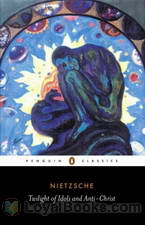 The Twilight of the Idols or How to Philosophise with the Hammer
Of The Twilight of the Idols, Nietzsche says in Ecce Homo: “If anyone should desire to obtain a rapid sketch of how everything before my time was standing on its head, he should begin reading me in this book. That which is called ‘Idols’ on the title-page is simply the old truth that has been believed in hitherto. In plain English, The Twilight of the Idols means that the old truth is on its last legs.” Certain it is that, for a rapid survey of the whole of Nietzsche’s doctrine, no book, save perhaps the section entitled “Of Old and New Tables” in Thus Spake Zarathustra, could be of more real value than The Twilight of the Idols... | |
 The Joyful Wisdom
The Joyful Wisdom (later translated as The Gay Science), written in 1882, just before Zarathustra, is rightly judged to be one of Nietzsche’s best books. Here the essentially grave and masculine face of the poet-philosopher is seen to light up and suddenly break into a delightful smile. The warmth and kindness that beam from his features will astonish those hasty psychologists who have never divined that behind the destroyer is the creator, and behind the blasphemer the lover of life. In the retrospective... | |
|
Ecce Homo
The philosopher Friedrich Nietzsche’s autobiography, Ecce Homo, was the last prose work that he wrote before his illness in 1889. Coming at the end of an extraordinarily productive year in which he had produced The Twilight of the Idols and The Antichrist, Nietzsche shuns any pretense at modesty with chapter titles include “Why I am so Wise”, “Why I am so Clever” and “Why I Write Such Excellent Books”. His translator Anthony M. Ludovici states, Ecce Homo “is not only a coping-stone... | |
|
Case of Wagner / Nietzsche Contra Wagner / Selected Aphorisms
A collection of three of Nietzsche's writings concerning the music of Wagner. In particular, he relates Wagner's music as degenerate, unrefined and unintelligent and relates it to a gradually degenerating German culture and society. The translator provides a detailed introduction. | |
|
Early Greek Philosophy and Other Essays
The essays contained in this volume treat of various subjects. With the exception of perhaps one we must consider all these papers as fragments. Written during the early Seventies, and intended mostly as prefaces, they are extremely interesting, since traces of Nietzsche's later tenets — like Slave and Master morality, the Superman — can be found everywhere. But they are also very valuable on account of the young philosopher's daring and able handling of difficult and abstruse subjects. "Truth and Falsity," and "The Greek Woman" are probably the two essays which will prove most attractive to the average reader. - from the Preface. | |