 |
Books Should Be Free Loyal Books Free Public Domain Audiobooks & eBook Downloads |
|
|
|
Books Should Be Free Loyal Books Free Public Domain Audiobooks & eBook Downloads |
|
Top Authors |
|---|
|
Book type:
Sort by:
|
By: Edith Wharton (1862-1937) | |
|---|---|
 Crucial Instances
This is Edith Wharton's second published collection of short stories (1901). One of these seven stories, "Copy: A Dialogue," is written as a short play. The role of Hilda is read by Arielle Lipshaw, and the role of Ventnor by Mark F. Smith. | |
 Madame de Treymes
Edith Wharton's 1907 novella explores the milieu of Americans living abroad in Paris. New Yorker John Durham travels to Paris to woo an old flame, Fanny Frisbee, now the Marquis de Malrive. Fanny is separated from her husband and wants to marry John and return to America, but she doubts whether her Catholic husband will grant her a divorce. When John meets Fanny's sister-in-law, the enigmatic Madame de Treymes, he hopes she may be able to help them in their quest for happiness. (Introduction by Elizabeth Klett) | |
 In Morocco
| |
|
The Early Short Fiction of Edith Wharton — Part 1
| |
 Tales of Men and Ghosts
Tales of Men and Ghosts was published as a collection in 1910, though the first eight of the stories had earlier appeared in Scribner's and the last two in the Century Magazine. Despite the title, the men outnumber the ghosts, since only "The Eyes" and "Afterward" actually call on the supernatural. In only two of the stories are women the central characters, though elsewhere they play important roles. Wharton enjoys subjecting her subjects -- all of them American gentlemen and gentlewomen, in the conventional senses of the word -- to various moral tests and sometimes ironic tests... | |
|
The Descent of Man and Other Stories
| |
|
Xingu 1916
| |
|
The Hermit and the Wild Woman
| |
|
Coming Home 1916
| |
|
The Triumph Of Night 1916
| |
|
The Choice 1916
| |
|
Kerfol 1916
| |
|
Autres Temps... 1916
| |
|
Artemis to Actaeon, and Other Verses
| |
By: Edgar Allan Poe (1809-1849) | |
|---|---|
 The Raven
When a modern film script draws inspiration from a poem written more than a century ago, readers can judge its impact on our collective imagination. Such is the resonance of the poem "The Raven" by Edgar Allan Poe. First published in 1845, "The Raven" is a masterpiece of atmosphere, rhythmic quality and use of language. Constructed in narrative form, it tells the story of a young man who is mourning the loss of his beloved. One December night as he wearily sits up browsing through a classical volume, a mysterious tapping against his window disturbs him... | |
 The Murders in the Rue Morgue
This story opens with a mother and daughter found brutally murdered inside a locked room in an upstairs apartment on a street in Paris. The police are baffled by both the ferocity of the crime and the lack of clues. Neighbors give conflicting evidence. Two friends are intrigued by the entire situation as reported in the newspapers. They decide to do a little investigating on their own. What they come up with is one of the most shocking and strangest of conclusions. The Murders in the Rue Morgue by Edgar Allan Poe is perhaps the first modern detective tale, though similar stories by Voltaire and ETA Hoffman did appear a few decades earlier... | |
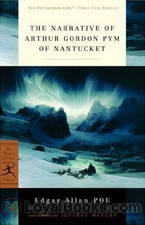 Narrative of Arthur Gordon Pym
Published in 1838, The Narrative of Arthur Gordon Pym of Nantucket is Poe’s only complete novel and concentrates on several sea adventures gone awry. The novel follows Arthur Gordon Pym, who finds himself in the center of gloomy occurrences on board numerous vessels, as his anticipated sea adventure takes a drastic shift in the wind. Shipwreck, starvation, mutiny, near death experiences and cannibalism are just some of the issues endured in the gripping, and at times gruesome novel. The adventure... | |
 Two Poe Tales
Edgar Allan Poe is best known for his famous short horror stories; however, horror is not the only genre in which he wrote. How To Write a Blackwood Article and its companion piece A Predicament are satirical works exploring the pieces of the formula generally seen in short horror stories (”articles”) found in the Scottish periodical “Blackwood’s Magazine” and the successful misapplication of said formula by – horrors! – a woman author! – respectively. | |
|
The Fall of the House of Usher
| |
|
The Cask of Amontillado
| |
|
Collection of Edgar Allan Poe
| |
|
The Masque of the Red Death
| |
By: James Joyce (1882-1941) | |
|---|---|
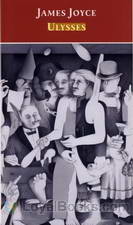 Ulysses
Banned in the United States and United Kingdom throughout the 1920s, Ulysses turned conventional ideas of the novel inside out with its bold new form, style and theme. Deeply rooted in the Greek myth of the hero of the Trojan War, Joyce bases his novel on Ulysses or Odysseus, who is doomed to voyage for ten years before returning home to Ithaca. Joyce had been deeply influenced by the Iliad and the Odyssey, which he had read from Charles Lamb's adaptations as a child. In fact, he considered him the epitome of the heroic ideal and constantly thought of giving the myth a new dimension in modern literature... | |
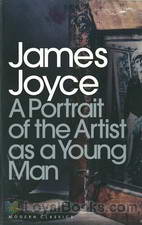 A Portrait of the Artist as a Young Man
His family name is derived from a Greek craftsman who created the Labyrinth and designed wings for himself and his son to fly away from the island they were imprisoned in. But Stephen Dedalus, the young hero of James Joyce's first novel, is a young man who rises above his baser instincts and seeks a life devoted to the arts. This quintessential coming of age novel describes the early life of Stephen Dedalus. It is set in Ireland during the nineteenth century which was a time of emerging Irish nationalism and conservative Catholicism... | |
 Dubliners
A young boy falls in love with his friend's much older sister and is desperate to get her the perfect gift from the Araby Fair. After a party, a man discovers something he had never known about his wife, which has a devastating impact on their marriage. An ambitious mother schemes to get her daughter a role in a series of concerts. A drunken legal clerk takes out his frustrations on his helpless young son. These and other brilliant stories are contained in the collection entitled Dubliners... | |
 The Dead
This novella is the final story in Joyce’s collection Dubliners. It describes a Christmas party given by Kate and Julia Morkan, two elderly Dublin ladies, that is attended by their nephew, Gabriel Conroy, and his wife. While the party is festive, full of dancing, drinking, and eating, it is also pervaded by political, religious, and sexual tensions, as well as memories of loss. When Gabriel and his wife go home at the end of the night, she reveals a long-kept secret that leads to an epiphany. | |
 Chamber Music
Chamber Music is a collection of poems by James Joyce, first published in May of 1907. The collection originally comprised thirty-four love poems, but two further poems were added before publication (”All day I hear the noise of waters” and “I hear an army charging upon the land”). Although the poems did not sell well, they received some critical acclaim. Ezra Pound admired the “delicate temperament” of these early poems, while Yeats described “I hear an army charging upon the land” as “a technical and emotional masterpiece”... | |
By: Giovanni Boccaccio (1313-1375) | |
|---|---|
 The Decameron
Giovanni Boccaccio’s The Decameron is a collection of novellas or short novels written during the 14th century. There are 100 tales contained in the book which is presented together. The book’s title The Decameron combines the two Greek words “deka” meaning ten and “hemera” meaning day. The title can be literally translated as “ten day,” which is also the time frame in which the stories are told by the 7 young women and 3 young men. In the book, each of the ten persons took their turns to tell stories for a day... | |
|
La Fiammetta
| |
By: H. Rider Haggard (1856-1925) | |
|---|---|
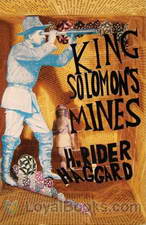 King Solomon's Mines
King Solomon’s Mines is the story of the leader Allan Quatermain and his adventurous group of followers on their mission to find the lost brother of an aristocrat, Sir Henry Curtis. Considered similar to Robert Louise Stevenson’s novel Treasure Island, Haggard’s book proved to be another must-read adventure novel in the international literary world. The African desert hides underneath its sands myths and legends that lasted for centuries in the minds of the locals. Quatermain has a mysterious map that could lead to the ancient mines of the wise King Solomon... | |
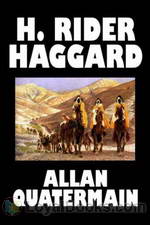 Allan Quatermain
“An Adventurer – He that goes out to meet whatever may come!” This is the credo of Allan Quatermain, the quintessential, swashbuckling protagonist of Allan Quatermain by H. Rider Haggard. Quatermain first makes his appearance as a character in Haggard's most famous bestselling adventure tale, King Solomon's Mines. Published in 1885, this Victorian action novel depicts a group led by Allan Quatermain who travel to a remote region in Africa in search of the missing brother of one of them. It is considered the very first English adventure tale set in what was perhaps disparagingly then called the “Dark Continent... | |
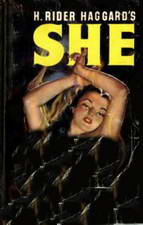 She
She
A timeless classic of fantasy literature, She is recognized as the groundwork for the lost world literary sub- genre. First published serially in The Graphic magazine from 1886 to 1887, the novel has reached critical acclaim with approximately 100 million copies sold and is regarded as one of the best-selling books of all time. Exploring themes of imperialism, lost civilization, female authority and psyche, the novel also serves as a mirror to reflect Victorian issues such as gender and race. ... | |