|
Books Should Be Free Loyal Books Free Public Domain Audiobooks & eBook Downloads |
|
|
|
Books Should Be Free Loyal Books Free Public Domain Audiobooks & eBook Downloads |
|
Top Authors |
|---|
|
Book type:
Sort by:
|
By: Bertrand Russell (1872-1970) | |
|---|---|
 Our Knowledge of the External World as a Field for Scientific Method in Philosophy
| |
By: Flavius Josephus (37 - c.100) | |
|---|---|
 The Antiquities of the Jews
Antiquities of the Jews was a work published by the important Jewish historian Flavius Josephus about the year 93 or 94. It is a history of the Jewish people, written in Greek for Josephus' gentile patrons. Beginning with the creation of Adam and Eve, it follows the events of the historical books of the Hebrew Bible, but sometimes omits or adds information.Volume 1 contains Books 1-5 and ends with the dedication of Samuel and death of Eli the priest. | |
 Minor Works of Josephus
There are 3 parts to this collection.(1) Against Apion is a two-volume defense of Judaism as classical religion and philosophy, stressing its antiquity, as opposed to what Josephus claimed was the relatively more recent tradition of the Greeks. Some anti-Judean allegations ascribed by Josephus to the Greek writer Apion, and myths accredited to Manetho are also addressed.(2) Discourse To The Greeks Concerning Hades describes the author's views on the afterlife against the prevailing view of the "Greeks" (i... | |
 Against Apion
| |
|
The Life of Flavius Josephus
| |
|
Josephus' Discourse to the Greeks Concerning Hades
| |
By: Emma Goldman (1869-1940) | |
|---|---|
 Anarchism and Other Essays
Chicago, May 4, 1886. In the Haymarket region of the city, a peaceful Labor Day demonstration suddenly turns into a riot. The police intervene to maintain peace, but they soon use violence to quell the mob and a bomb is thrown, resulting in death and injuries to scores of people. In the widely publicized trial that followed, eight anarchists were condemned to death or life imprisonment, convicted of conspiracy, though none of them had actually thrown the bomb. A young Russian immigrant, Emma Goldman, had arrived just the previous year in the United States... | |
|
Marriage and Love
| |
By: Arthur Schopenhauer (1788-1860) | |
|---|---|
 Studies in Pessimism
Arthur Schopenhauer, an early 19th century philosopher, made significant contributions to metaphysics, ethics, and aesthetics. His work also informed theories of evolution and psychology, largely through his theory of the will to power – a concept which Nietzsche famously adopted and developed. Despite this, he is today, as he was during his life, overshadowed by his contemporary, Hegel. Schopenhauer’s social/psychological views, put forth in this work and in others, are directly derived from his metaphysics, which was strongly influenced by Eastern thought... | |
|
The Essays of Arthur Schopenhauer: the Wisdom of Life
| |
|
The Essays of Arthur Schopenhauer; On Human Nature
| |
|
The Essays of Arthur Schopenhauer; Religion, a Dialogue, Etc.
| |
|
The Essays of Arthur Schopenhauer; Counsels and Maxims
| |
|
The Essays of Arthur Schopenhauer; the Art of Controversy
| |
|
The Essays of Arthur Schopenhauer; The Art of Literature
| |
By: Walter Crane (1845-1915) | |
|---|---|
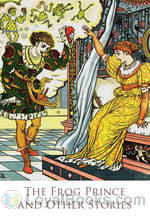 The Frog Prince and Other Stories
The three charming stories contained in The Frog Prince and Other Tales include a less-known fairy-tale called Princess Belle-Etoile besides the title story and Alladin and the Wonderful Lamp. Published in 1874, the tales are re-told by the famous illustrator Walter Crane, who has also provided some of the most lovely illustrations in the book. The book makes an ideal gift and both parents and children will certainly enjoy it. It's perfect for bedtime story-reading sessions and kids would love gazing at the beautiful Greek-style illustrations that are scattered throughout the book... | |
|
Line and Form (1900)
| |
|
The Sleeping Beauty Picture Book
| |
|
A Floral Fantasy in an Old English Garden
| |
|
The Absurd ABC
| |
|
Eight Illustrations to Shakespeare's Tempest Designed by Walter Crane
| |
|
The Song of Sixpence Picture Book
| |
|
An Alphabet of Old Friends
| |
|
The Buckle My Shoe Picture Book
| |
|
Queen Summer or, The Tourney of the Lily and the Rose
| |
|
Mother Hubbard, Her Picture Book, Containing Mother Hubbard, The Three Bears, & The Absurd A, B, C.
| |
By: Laurence Sterne (1713-1768) | |
|---|---|
 The Life and Opinions of Tristram Shandy, Gentleman
This is volume 1 of 4.The Life and Opinions of Tristram Shandy, Gentleman (or, more briefly, Tristram Shandy) is a novel by Laurence Sterne. It was published in nine volumes, the first two appearing in 1759, and seven others following over the next 10 years. It was not always held in high esteem by other writers (Samuel Johnson responded that, “Nothing odd can last”), but its bawdy humour was popular with London society, and it has come to be seen as one of the greatest comic novels in English, as well as a forerunner for many modern narrative devices. | |
 A Sentimental Journey Through France and Italy
After the bizarre textual antics of “Tristram Shandy”, this book would seem to require a literary health warning. Sure enough, it opens in mid-conversation upon a subject never explained; meanders after a fashion through a hundred pages, then fizzles out in mid-sentence – so, a plotless novel lacking a beginning, a middle or an end. Let us say: an exercise in the infinitely comic. “There is not a secret so aiding to the progress of sociality, as to get master of this short hand, and to be quick in rendering the several turns of looks and limbs with all their inflections and delineations, into plain words... | |
|
A Political Romance
| |
By: David Hume (1711-1776) | |
|---|---|
 An Enquiry Concerning Human Understanding
The Enquiry Concerning Human Understanding is a shortened and simplified version of Hume’s masterpiece A Treatise of Human Nature. It sought to reach a wider audience, and to dispel some of the virulent criticism addressed toward the former book. In it, Hume explains his theory of epistemology, and argues against other current theories, including those of John Locke, George Berkeley, and Nicolas Malebranche. | |
 Dialogues Concerning Natural Religion
In Dialogues Concerning Natural Religion, philosopher David Hume examines whether belief in God can be rational. The work takes the form of a debate between three characters: Cleanthes, who argues that the existence and nature of God can be empirically verified; Demea, who argues that God is completely beyond human knowledge; and Philo, a philosophical skeptic widely thought to represent Hume’s own beliefs. Much of the debate centers around Cleanthes’ presentation of the analogical argument from design... | |
 A Treatise Of Human Nature
This book, published in two volumes called “books” by the author, is a treatment of everything from the origin of our ideas to how they are to be divided. It includes important statements of Scepticism and Hume’s experimental method. Part 1 deals with the nature of ideas. Part 2 deals with the ideas of space and time. Part 3 deals with knowledge and probability. Part 4 deals with skeptical and other systems of philosophy, including a discussion of the soul and personal identity.This is a recording of Volume I (or Book 1). Volume II (which contains Books 2 and 3) is in production at the moment. | |
 History of England from the Invasion of Julius Caesar to the Revolution of 1688, Volume 1A
David Hume is one of the great philosophers of the Western intellectual tradition. His philosophical writings earned him lasting fame and renown; his historical writing earned his bread and butter. His "The History of England from the Invasion of Julius Caesar to the Revolution of 1688", published between 1754 and 1764, was immensely popular and Hume wrote that "the copy-money given me by the booksellers much exceeded any thing formerly known in England; I was become not only independent, but opulent... | |
|
Enquiry Concerning the Principles of Morals
| |
|
Essays
| |
|
The History of England, Volume I
| |
By: Harry Harrison (1925) | |
|---|---|
 Deathworld
Jason dinAlit, an inhabitant of the planet Porgostrosaand, is a fast talking, conniving, tough as nails, gun toting gambler whose ethics wax and wane with each planet he travels to. He also has amazing psionic abilities which means he is gifted with a variety of psychic abilities including telekinesis, telepathy, pyrokinesis and a host of other interesting capabilities. He is not above using these to tip the odds in his favor while gambling. A chance meeting with Kerk Pyrrus who is the Ambassador of planet Pyrrus ends up with dinAlit traveling back with the Ambassador to Pyrrus... | |
 Planet of the Damned
Once in a generation, a man is born with a heightened sense of empathy. Brion Brandd used this gift to win the Twenties, an annual physical and mental competition among the best and smartest people on Anvhar. But scarcely able to enjoy his victory, Brandd is swept off to the hellish planet Dis where he must use his heightened sense of empathy to help avert a global nuclear holocaust by negotiating with the blockading fleet, traversing the Disan underworld, and cracking the mystery of the savagely ruthless magter. Summary by Great Plains. | |
 The Ethical Engineer
The Ethical Engineer also known as Deathworld II finds our hero Jason dinAlt captured to face justice for his crimes, but the ever-wily gambler crashes his transport on a primitive planet populated by clans that hoard knowledge. It’s a difficult situation for a guy who just wants to get back to Pyrrus. – The Ethical Engineer was first published in the July and August 1963 issues of Analog Science Fact & Fiction. | |
 Arm of the Law
A quiet backwater outpost on Mars gets a surprise in the form of a new police recruit - in a box! Yep, it's a prototype robot cop sent to the backwater station for testing. And Harrison tells the strange, funny and scary things that begin to happen after that, as only he can. | |
|
Toy Shop
| |
|
Navy Day
| |
|
The Velvet Glove
| |
 Sense of Obligation
| |
By: Robert E. Howard (1906-1936) | |
|---|---|
 Red Nails
Conan the Cimmerian pursues the beautiful and deadly pirate Valeria after she kills a Stygian only to find himself cornered by a dragon. Apparently this dragon doesn’t know who he’s messing with. The pair then encounters the city of Xuchotl with its warring factions and ancient secrets. Swordplay and sorcery ensue. – Red Nails is Howard’s final Conan story and was published in the July, August, September and October 1936 issues of Weird Tales magazine | |
By: Frederick Douglass (1818-1895) | |
|---|---|
 Narrative of the Life of Frederick Douglass
Frederick Douglass was born into slavery on a Maryland plantation. He faced hardship as a child, but later encountered owners who were relatively liberal and allowed him to learn to read, write and be in contact with freed slaves. At the age of 20, he escaped from the plantation and made his way to New York. Though he remained a fugitive, he married and changed his name to avoid being caught. He continued his education and became involved in the Abolitionist Movement. He began touring the country, speaking passionately about the unjust, cruel and inhuman practice of slavery... | |
By: Frederick Douglass (c.1818-1895) | |
|---|---|
|
Collected Articles of Frederick Douglass
These two articles were reproduced as an e-book by Project Gutenberg in 2008 to supplement "...several articles by Frederick Douglass, whose larger work was presented in book form as a January, 1993 Project Gutenberg Etext to commemorate Martin Luther King Jr. Day...." The articles narrated here are "My Escape From Slavery" (1881) and "Reconstruction" (1866). | |
By: Charles Perrault (1628-1703) | |
|---|---|
 The Fairy Tales of Charles Perrault
This book is an early collection of ten well-known fairy tales. It is thought to have begun the genre of fairy tales. | |
|
Contes des fées
| |
|
Old-Time Stories
| |
 Tales of Passed Times
| |
By: Edwin Abbott Abbott (1838-1926) | |
|---|---|
 Flatland: A Romance of Many Dimensions
If you've never heard the term “Mathematical Fiction” before, Edwin Abbott Abbott's 1884 novella, Flatland can certainly enlighten you! Flatland: A Romance of Many Dimensions was published in 1884 and since then, it has been discovered and re-discovered by succeeding generations who have been delighted by its unique view of society and people. The plot opens with a description of the fictional Flatland. The narrator calls himself “Square” and asks readers to “Imagine a vast sheet of paper on which straight Lines, Squares, Triangles, Pentagons, Hexagons and other figures, instead of remaining fixed in their places, move freely about... | |
|
Flatland: a romance of many dimensions (Illustrated)
| |
|
How to Write Clearly Rules and Exercises on English Composition
| |
By: P. G. Wodehouse (1881-1975) | |
|---|---|
 The Clicking of Cuthbert
The first of two books that he wrote on golfing themes, The Clicking of Cuthbert by PG Wodehouse sparkles with typical Wodehousian wit, humor and general goofiness! An avid golfer himself, Wodehouse published the ten stories in this volume in 1922. In 1924, an American edition titled Golf Without Tears was published. Since then it has enjoyed undimmed popularity among both Wodehouse fans and golfing enthusiasts. Nine of the stories contained in this book are narrated by the Oldest Member, a character who has become a cult figure among Wodehouse fans... | |
 The Intrusion of Jimmy
The action begins with playboy bachelor Jimmy Pitt in New York; having fallen in love on a transatlantic liner, he befriends a small-time burglar and breaks into a police captain's house as a result of a bet. The cast of characters head to England, and from there on it is a typically Wodehousian romantic farce, set at the stately Dreever Castle, overflowing with imposters, detectives, crooks, scheming lovers and conniving aunts. | |
 Jill the Reckless
Jill had money, Jill was engaged to be married to Sir Derek Underhill. Suddenly Jill becomes penniless, and she is no longer engaged. With a smile, in which there is just a tinge of recklessness, she refuses to be beaten and turns to face the world. Instead she goes to New York and becomes a member of the chorus of "The Rose of America," and Mr. Wodehouse is enabled to lift the curtain of the musical comedy world. There is laughter and drama in _Jill the Reckless_, and the action never flags from the moment that Freddie Rooke confesses that he has had a hectic night, down to the point where Wally says briefly "Let 'em," which is page 313... | |
 The Coming of Bill
The Coming of Bill tells the story of Kirk Winfield, his marriage to Ruth, and their child called Bill. Bill's upbringing is threatened by the interference of Ruth's busybody writer aunt, Mrs Lora Delane Porter. | |