 |
Books Should Be Free Loyal Books Free Public Domain Audiobooks & eBook Downloads |
|
|
|
Books Should Be Free Loyal Books Free Public Domain Audiobooks & eBook Downloads |
|
Fantasy Books |
|---|
|
Book type:
Sort by:
View by:
|
By: Haggard, H. Rider (1856-1925) | |
|---|---|
 Ayesha, the Return of She
Ayesha, the return of She, is set 16 years after the previous novel She. Horace Holly and Leo Vincey have spent the years travelling the world looking for Ayesha, along the way they experience many adventures, including avalanches, glaciers and even death-hounds before finally arriving in the court of Kaloon. At the court, they hear tell of a woman who Leo suspects to be Ayesha, however things are never simple and conflict soon follows them to Ayesha’s court. (Summarised from Wikipedia) | |
By: Henry Beston | |
|---|---|
 The Firelight Fairy Book
One pleasant summer day, as the fairy-tale lover sat reading a book beneath the low spreading branches of an oak tree, he heard a hum of wings, and looking up startled from his book, he discovered the Fairy Goldenwand standing close by. "Are you still seeking new fairy tales?" said the Fairy Goldenwand. "Yes," said the reader. "Will you write them down if I tell you some really new ones?" said the Fairy. "Oh yes, indeed," said the reader. "And I'll put them into a book;..." "Oh, that will be fine!" said the Fairy Goldenwand... | |
By: Henry Fielding (1707-1754) | |
|---|---|
 Journey from this World to the Next
The narrator dies in the first sentence. Through relating his travels in the afterlife, Henry Fielding, author of Tom Jones and Joseph Andrews, gently satirizes life here on earth. | |
By: Heywood Broun (1888-1939) | |
|---|---|
 Seeing Things at Night
This Book is a collection of humorous short stories which describe the comedy in everyday things and situations. | |
By: Hugh Lofting (1886-1947) | |
|---|---|
 The Voyages of Doctor Dolittle
The delightfully eccentric Doctor Dolittle, rendered immortal on screen by the gifted Rex Harrison, has remained a firm favorite with generations of children ever since he made his debut in an earlier novel, The Story of Doctor Dolittle. In his second outing titledThe Voyages of Doctor Dolittle, the maverick physician takes on a new assistant, Tommy Stubbins. The story is structured as a first person account given by Tommy, who is now a very old man. The boy who was the son of the village cobbler first meets Doctor Dolittle when he takes a hurt squirrel to the doctor for treatment... | |
 The Story of Doctor Dolittle
An adventurous children’s novel, The Story of Doctor Dolittle is the first book in the Doctor Dolittle series. The novel depicts the many adventures of Dr. John Dolittle as he learns the language of animals and takes on various feats including exotic travel, a dangerous encounter with pirates, and a mission to set right from wrong. The novel begins with the introduction of Dr. John Dolittle, an animal lover and respected physician, who lives in the small English town of Puddleby-on-the-Marsh with his unmarried sister... | |
By: J. M. Barrie (1860-1937) | |
|---|---|
 Peter Pan
His name has become a metaphor for one who will never grow old. Peter Pan by JM Barrie is the story of a boy who remains a boy while the world around him changes. Sir James Mathew Barrie was a Scottish playwright and novelist whose works were received with great critical and commercial success in the late nineteenth and early twentieth century. He discovered the main inspiration for his creative genius in his friendship (and later guardianship) with the children of Arthur and Sylvia Llewellyn-Davies... | |
 The Story of Peter Pan
THE STORY OF PETER PAN RETOLD FROM THE FAIRY PLAY BY SIR J.M. BARRIE BY DANIEL O'CONNOR. Basically, Daniel O'Connor took the story from the original play, with the approval of Barrie, and shortened it into a book with music and beautiful illustrations. This shorter book was published before Barrie wrote the longer novel using the same plot and characters. | |
|
Peter and Wendy
Peter and Wendy tells the classic story of Peter Pan, a mischievous little boy who can fly, and his adventures on the island of Neverland with Wendy and her brothers, the fairy Tinker Bell, the Lost Boys, the Indian princess Tiger Lily, and the pirate Captain Hook. (Introduction modified from Wikipedia) | |
By: J. Walker McSpadden (1874-1960) | |
|---|---|
 Robin Hood
Robin Hood is a heroic outlaw in English folklore. A highly skilled archer and swordsman, he is known for "robbing from the rich and giving to the poor", assisted by a group of fellow outlaws known as his "Merry Men". Traditionally Robin Hood and his men are depicted wearing Lincoln green clothes. The origin of the legend is claimed by some to have stemmed from actual outlaws, or from ballads or tales of outlaws. | |
By: Jack London (1876-1916) | |
|---|---|
|
Before Adam
"Before Adam is a mixture of sound science and sci-fi speculation. It is based around Darwin's theory of evolution and the idea of racial memory. The main character lives in the current world but has dreams and nightmares that he relives the pre-stone age life of one of his proto-human ancestors. Those who are scientifically inclined may enjoy this novel more than fans of "standard" science fiction such as Edgar Rice Burroughs. | |
By: James Blish (1921-1975) | |
|---|---|
 The Thing in the Attic
Honath the Pursemaker is a heretic. He doesn’t believe the stories in the Book of Laws which claims giants created his tree-dwelling race. He makes his opinion known and is banished with his infidel friends to the floor of the jungle where dangers abound. Perhaps he’ll find some truth down there. – The Thing in the Attic is one of Blish’s Pantropy tales and was first published in the July, 1954 edition of If, Worlds of Science Fiction magazine. | |
By: James Elroy Flecker (1884-1915) | |
|---|---|
|
King of Alsander (Dramatic Reading)
First published in 1914, the King of Alsander is the only novel by James Elroy Flecker, best known as a poet, but also a noted scholar, linguist and diplomat. Flecker's love of learning, language and travel, and his keen satirical insight into politics are all in evidence in this phantasmagoric tale. As the author himself describes it: Here is a tale all romance - a tale such as only a Poet can write for you, O appreciative and generous Public - a tale of madmen, kings, scholars, grocers, consuls,... | |
By: Jay Franklin (1897-1967) | |
|---|---|
|
Rat Race
When an atomic explosion destroys the battleship Alaska, Lt. Commander Frank Jacklin returns to consciousness in New York and is shocked to find himself in the body of Winnie Tompkins, a dissolute stock-broker. Unable to explain his real identity, Jacklin attempts to fit into Tompkins' way of life. Complications develop when Jacklin gets involved with Tompkins' wife, his red-haired mistress and his luscious secretary. Three too many women for Jacklin to handle. His foreknowledge of the Alaska sinking... | |
By: Jean Ingelow (1820-1897) | |
|---|---|
 Mopsa the Fairy
Jean Ingelow (1820 – 1897) was one of the more famous poets of the period, indeed many people suggested that she should succeed Alfred, Lord Tennyson as the first female Poet Laureate when he died in 1892. Mopsa the Fairy, written in 1869 is one of her more enduring stories. It is a delightful fantasy about a young boy who discovers a nest of young fairies and tells of their adventures together. | |
By: Joel Chandler Harris (1848-1908) | |
|---|---|
 Uncle Remus and Brer Rabbit
Uncle Remus' stories feature a trickster hero called Br'er Rabbit ("Brother" Rabbit), who uses his wits to slide out of trouble and gain the advantage over the slower witted other animals, many of whom are trying to eat him. Br'er Rabbit stories were mostly collected directly from the afro-american oral story-telling tradition and are said to be a direct interpretation of Yoruba tales of Hare. This book contains 11 unique stories and was the last one published before the author's death. (Introduction by Phil Chenevert) | |
By: John Bunyan | |
|---|---|
 The Holy War
The Holy War is perhaps John Bunyan’s second most popular work, after The Pilgrim’s Progress. It tells the story of afierce battle to take control of a city from its rightful ruler. | |
By: John C. Hutcheson (1840-1897) | |
|---|---|
 The Ghost Ship
This book intentionally veers in and out of the supernatural, as the title implies. The officers get more and more bewildered as they work out their position, and yet again encounter the same vessel going in an impossible direction. Having warned you of this, I must say that it is a well-written book about life aboard an ocean-going steamer at about the end of the nineteenth century. | |
By: John Kendrick Bangs (1862-1922) | |
|---|---|
 Alice in Blunderland: an Iridescent Dream
John Kendrick Bangs (May 27, 1862 – January 21, 1922) was an American author and satirist, and the creator of modern Bangasian Fantasy, the school of fantasy writing that sets the plot wholly or partially in the afterlife. (Wikipedia)Plot summary: J K Bangs has taken Alice from Lewis Carroll’s “Alice in Wonderland” and lets her on a boring day travel with the Mad Hatter, the March Hare, the Cheshire Cat and the other of Carroll’s familiar characters to Blunderland. The story is a well written Satire, a witty, humorous tale of adventure and city politics, a tale of Alice in a land where nothing is as it should be. (Summary by Lars Rolander) | |
 A House-Boat on the Styx
The premise of the book is that everyone who has ever died (up until the time in which the book is set, which seems to be about the time of its publication) has gone to Styx. This does not appear to be the conventional Hell described by Dante in The Inferno, but rather the Hades described in Greek myth (both of which had Styxes): a universal collecting pot for dead souls, regardless of their deeds in life. The book begins with Charon, ferryman of the Styx (in The Inferno, he was the ferryman of the river Acheron) being startled—and annoyed—by the arrival of a house boat on the Styx... | |
 The Pursuit of the House-Boat
This sequel to Bangs' A House-Boat on the Styx continues the "thought-experiment" of bringing various historical and fictional figures together, detailing the adventures of the ladies of Hades after they are kidnapped by pirates and the attempts of the Associated Shades (led by Sherlock Holmes) to retrieve their house-boat. (Introduction by Emma Joyce) | |
 Mr Munchausen
The author has discovered for us in this volume the present stopping place of that famous raconteur of dear comic memory, the late Hieronymous Carl Friederich, sometime Baron Munchausen, and he transmits to us some further adventures of this traveler and veracious relator of merry tales. There are about a dozen of these tales, and, judging by Mr. Bangs' recital of them, the Baron's adventures on this mundane sphere were no more exciting than those he has encountered since taking the ferry across the Styx... | |
|
Enchanted Typewriter
The Enchanted Typewriter is a collection of short stories by the American author John Kendrick Bangs, written in 1899 in the style that has become known as Bangsian fantasy. Bangs attributes many of the stories to the late (and invisible) James Boswell, who has become an editor for a newspaper in Hades, and who communicates with the author by means of an old typewriter. The fantasy stories in this book are part of the author's Hades series, named for the stories' setting. | |
By: John Lang (1816-1864) | |
|---|---|
 Gulliver's Travels, Told to the Children
This is a children's version of Jonathan Swift's novel Gulliver's Travels, from the Told to the Children Series (published in 1910). The children's adventure story covers Gulliver's visits to the lands of Lilliput and Brobdingnag. | |
By: John Rae (1882-1963) | |
|---|---|
|
New Adventures of Alice (version 2 Dramatic Reading)
After reading and re-reading the book many time as a boy and wishing that Lewis Carroll would have written another Alice In Wonderland Book, John Rae began imagining what that girl would have gotten up to if he had done so. Telling these stories to his children over the years, where they were enthusiastically received, he finally decided to share them with the world. And here they are! The New Adventures of Alice | |
By: John W. Campbell (1910-1971) | |
|---|---|
 The Ultimate Weapon
The star Mira was unpredictably variable. Sometimes it was blazing, brilliant and hot. Other times it was oddly dim, cool, shedding little warmth on its many planets. Gresth Gkae, leader of the Mirans, was seeking a better star, one to which his "people" could migrate. That star had to be steady, reliable, with a good planetary system. And in his astronomical searching, he found Sol.With hundreds of ships, each larger than whole Terrestrial spaceports, and traveling faster than the speed of light, the Mirans set out to move in to Solar regions and take over... | |
By: Jonathan Swift (1667-1745) | |
|---|---|
 Gulliver's Travels
Comprised of four parts, Gulliver’s Travels documents the bizarre, yet fascinating voyages of Lemuel Gulliver as he makes his way through several uncharted destinations, experiencing the lives of the small, the giant, the scientific, and downright eccentric societies. Narrated in first person, Swift successfully portrays Gulliver’s thoughts and reactions as he faces struggles of integration throughout his travels. Beginning with the introduction of Gulliver, an educated ship’s surgeon, who after a series of unfortunate events is victim to repeated shipwrecks, desertions, and set adrift... | |
By: Joseph Jacobs (1854-1916) | |
|---|---|
 English Fairy Tales
Jack the Giant-Killer, Tom Thumb, Goldilocks and The Three Bears, Henny Penny, Dick Whittington, The Three Little Pigs, Red Riding Hood and a host of immortal characters are found in this delightful collection of English Fairy Tales by Joseph Jacobs. The book made its first appearance in 1890 and has remained a firm favorite with both young and old ever since. Fairy tales have traditionally emanated from France and Germany. The famous compilations by La Fontaine and the Brothers Grimm have overshadowed children's literature for centuries... | |
By: Joseph Smith Fletcher (1863-1935) | |
|---|---|
 Dead Men's Money
A naïve but sincere young lawyer's assistant who only dreams of marrying his childhood sweetheart and yearns to have a home and family with her. His sharp witted boss keeps the firm going by dint of shrewd business sense and legal talent. When the assistant accidentally stumbles into a murder case, the scene is set for events that change all their lives. Dead Men's Money by Joseph Smith Fletcher was published in 1920, the era considered to be the Golden Age of detective fiction. Writers like Agatha Christie, Ngaio Marsh, Dorothy L... | |
By: Jules Verne (1828-1905) | |
|---|---|
 Twenty Thousand Leagues Under the Sea
An early science fiction novel written by the second most translated author, French writer Jules Verne, the classic tale depicts an incredible sea expedition on board a state-of-the-art submarine. First published in 1870 and a part of the Voyages Extraordinaires series, the novel is regarded as one of the most thrilling adventure stories and one of Verne’s greatest pieces of work. Immersed in themes of exploration, avant-garde technology, and man’s insatiable desire for knowledge and scientific progression, Twenty Thousand Leagues Under the Sea has been an influence for many writers as well as an inspiration for numerous film adaptations... | |
 A Journey to the Interior of the Earth
A historical manuscript penned by a medieval Norse poet. A mysterious code. Three intrepid explorers. A subterranean world filled with prehistoric creatures and proto-humans. These are some of the brilliant ideas that are superbly blended in A Journey to the Interior of the Earth by Jules Verne. Jules Verne, the French writer who created several works of science fiction, adventure stories and very popular novels, wrote A Journey to the Interior of the Earth in 1864. Some of his other books explore different aspects of geography, space and time travel... | |
 From the Earth to the Moon
One of the earliest examples of literature written in the science fiction genre, From the Earth to the Moon is a part of the Voyages Extraordinaires series by French novelist Jules Verne. Written more than a century before the Apollo mission, Verne’s classic is somewhat a prophetic novel of man’s travel to the moon with its thorough and descriptive detail. A remarkable blend of action, humor, science, and audacious schemes, the timeless classic is sure to fascinate with its unique vision of lunar exploration... | |
 Off on a Comet
The story starts with a comet that touches the Earth in its flight and collects a few small chunks of it. Some forty people of various nations and ages are condemned to a two-year-long journey on the comet. They form a mini-society and cope with the hostile environment of the comet (mostly the cold). The size of the 'comet' is about 2300 kilometers in diameter - far larger than any comet or asteroid that actually exists. | |
 Doctor Ox's Experiment
An early, light-hearted short story, published in 1872 by Jules Verne. It takes place in the Flemish town of Quiquendone, where life moves at an extraordinarily tranquil pace. Doctor Ox has offered to light the town with a new gas, but actually has other plans in place. | |
|
Master Zacharius
Master Zacharius is a man of science, skill, and overpowering pride. He is the first to successfully, and accurately, regulate time. Does this not make him God-like? What then, should such a man do when his time is running out and his legacy is in danger? | |
By: Kenneth Grahame (1859-1932) | |
|---|---|
 The Reluctant Dragon
Regarded as one of Grahame’s most distinguished short stories, the children’s classic was first published in 1898 and featured in Dream Days, a reminiscent short story collection for children, and has also been adapted into a feature film from Walt Disney Productions. The story centers on the events following the discovery of a dragon living inside a cave near a small town, which its residents perceive as dangerous and a threat to their safety, whereas as a young boy goes out of his way to prove the dragon’s harmless nature... | |
 Dream Days
Dream Days is a collection of children’s fiction and reminiscences of childhood written by Kenneth Grahame. A sequel to Grahame’s 1895 collection The Golden Age (some of its selections feature the same family of five children), Dream Days was first published in 1898 under the imprint John Lane: The Bodley Head. (The first six selections in the book had been previously published in periodicals of the day—in the Yellow Book, the New Review, and in Scribner’s Magazine in the United States.) The book is best known for its inclusion of Grahame’s classic story The Reluctant Dragon... | |
By: L. Adams Beck (1862-1931) | |
|---|---|
 The ninth vibration and other stories
This is a collection of the following short stories: The Ninth Vibration -- The Interpreter : A Romance of the East -- The Incomparable Lady : A Story of China with a Moral -- The Hatred of the Queen : A Story of Burma -- Fire of Beauty -- The Building of the Taj Majal -- How Great is the Glory of Kwannon! -- The Round-Faced Beauty. Many of them are romantic, some of them are fantasy and others are occult fiction.(Introduction by Linda Andrus) | |
By: L. Frank Baum (1856-1919) | |
|---|---|
 Dorothy and the Wizard in Oz
Its publication soon after the 1906 San Francisco earthquake got readers instantly hooked on the story in which Dorothy and her friends sink into the bowels of the earth, following a devastating earthquake in California. Dorothy and the Wizard in Oz is the fourth in the series of books written by American children's author L. Frank Baum. In this novel, Dorothy visits her Uncle Henry in his California ranch. She, her friends, her cousins and a few pets are traveling in a buggy when the earth suddenly splits open and the entire lot falls into the crack... | |
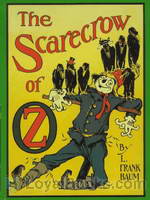 The Scarecrow of Oz
Published in 1915, The Scarecrow of Oz is the ninth book in the Oz book series and focuses on the adventures of Cap’n Bill, Trot, and the Scarecrow, who find themselves entangled in the politics of Jinxland and must work against formidable odds to overthrow its despot and restore rule to its rightful successor. Apart from the appearances of familiar faces, the novel also accommodates a fresh set of characters and magical creatures residing in the Land of Oz, further contributing to its classification as a typical Baum masterpiece... | |
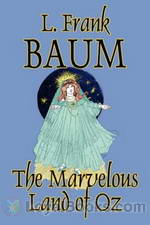 The Marvelous Land of Oz
Published in 1904, The Marvelous Land of Oz is the second book in Baum’s Oz series and follows the adventures of Tip, a young boy who travels the mystical Oz after running away from the terrifying witch Mombi. Furthermore, the novel reunites readers with familiar characters including the Scarecrow, Tin Woodman, Glinda the Good Witch, while also introducing bright new characters who deem to be just as memorable. Unlimited action, intense magic, captivating characters, and an unexpected twist, the adventure novel has remained a classic for generations, and has only strengthened the series appeal with its fresh intake on the familiar set... | |
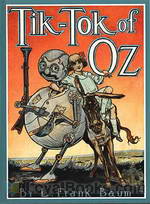 Tik-Tok of Oz
Betsy Bobbin encounters many strange and exciting adventures and people in the land of Oz; a side-plot is Queen Ann of Oogaboo’s mission to take over Oz. | |
 The Lost Princess of Oz
Who is stealing all the magic in Oz? Dorothy and her friends set out to comb all of Oz, not only for magic stolen from Glinda and the Wizard, but also for the kidnapped princess, Ozma. Along the way, they explore regions never seen in other Oz books, meeting strange and interesting people and animals, and falling into peril more than once. It’s a desperate mission – for if the thefts are all linked, then it means that some magician unknown to them has acquired powers beyond any available to them now. How will they find him? And how will they conquer him? Not one of them knows – but with continuing faith that goodness will triumph, they march forth to try. | |
 Sky Island
Published in 1912, the fantasy novel focuses on the exciting adventures of Trot, Cap’n Bill and Button Bright, as they are accidentally transported to a mysterious island in the sky, where they encounter its eccentric residents, an unscrupulous ruler, and a strange set of laws. The story sets into motion when Trot, a little girl from the southern coast of California, and Cap’n Bill meet a peculiar young boy carrying a large umbrella. Introduced as Button Bright, the young boy reveals that... | |
 Little Wizard Stories of Oz
The “Little Wizard Stories of Oz” are six short stories written by L. Frank Baum in 1913. By all accounts, Baum intended to finish the Oz series with “The Emerald City of Oz,” published in 1910. Following that, he attempted to write non-Oz books, publishing “The Sea Fairies” in 1911 and “Sky Island” in 1912. But, (as Baum himself laments in the prefaces of many of his Oz books,) his “little tyrants” were only interested in hearing more Oz stories. So in 1913, he returned to writing about Oz, putting out both The “Little Wizard Stories” and “The Patchwork Girl of Oz” that year... | |
 The Enchanted Island of Yew
A fairy has become bored with her life, and convinces some young girls to transform her into a human boy so she can go on adventures. The adventures come fast and furious, as the newly-named Prince Marvel explores the surrounding kingdoms. A masochistic squire accompanies Marvel, helping him with assorted kings, knights, dragons, and other medieval menaces along the way. | |
 The Master Key
The Master Key was one of Baum’s earliest full length fantasy books for children, published in 1901 just one year after The Wonderful Wizard of Oz. The protagonist, Rob, while experimenting in his workshop, accidentally summons up an electrical fairy who presents him with electrical devices so advanced as to seem magical. His gifts include a flying contraption, a stun gun, and something resembling an omniscient portable TV set. Rob travels the world, rendering assistance to European heads of state and narrowly escaping disaster at the hands of “primitive” cannibals, Turks and Tatars, pirates, and evil scientists who try to steal his inventions... | |
 Glinda of Oz
Glinda of Oz is the fourteenth Land of Oz book and is the last one written by the original author L. Frank Baum, although the series was continued after his death by several other authors. Dorothy and Ozma discover that a war is brewing in a distant and unexplored part of Oz, between two mysterious races, the Flatheads and the Skeezers. The girls set out to try to prevent the fighting, not knowing what dangers await them. | |
 The Magic of Oz
L. Frank Baum’s last beloved Oz book before his death, this story deals with the discovery of a powerful magic word by a young boy from Oz, who immediately is plunged head-first into adventure through his discovery. | |
 Rinkitink in Oz
Rinkitink in Oz is the tenth book in the Oz series written by L. Frank Baum, first published in 1916. It was originally written in 1905 as a stand alone fantasy work and subequently rewritten as an Oz book. Therefore, most of the action takes place outside of Oz in neighboring fairy countries. It tells the story of Prince Inga’s quest to rescue his parents from captivity after his island home is ravaged by enemies. With the help of three magical pearls and the more dubious assistance of the excessively... | |
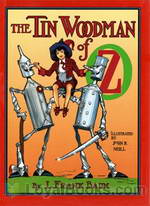 The Tin Woodman of Oz
The Tin Woodman of Oz is the twelfth Land of Oz book written by L. Frank Baum and was originally published on May 13, 1918. The Tin Woodman is unexpectedly reunited with his Munchkin sweetheart Nimmie Amee from the days when he was flesh and blood. This was a backstory from The Wizard of Oz. | |
 The Sea Fairies
In 1910, Baum hoped to end the Oz series and follow with a new series about a little girl named Trot and her sailor companion, Cap’n Bill. The Sea Fairies (1911) was the first book in the projected series and took Trot and Cap’n Bill under the sea where they had adventures with mermaids and other fantastic creatures. It was followed by Sky Island (1912) and then Baum returned to the Oz titles. He brought Trot and Cap’n Bill to Oz in the Scarecrow of Oz (1915). | |
 The Patchwork Girl of Oz
An unlucky Munchkin boy named Ojo must travel around Oz gathering the ingredients for an antidote to the Liquid of Petrifaction which has turned his beloved uncle Unc Nunkie and the wife of the Liquid's creator into marble statues. Ojo is joined by the patchwork girl Scraps, Dorothy, Dr. Pipt's Glass Cat, the Woozy, the Shaggy Man, the Scarecrow and the Tin Woodman. They eventually visit the Emerald City to ask for help from the Wizard of Oz. | |
 The Surprising Adventures of the Magical Monarch of Mo and His People
The Magical Monarch of Mo is a set of stories about the titular king, his queen, and his royal children. The stories are uproariously funny, dealing with topics as absurd as a man losing his temper who then tries to find it, an evil midget who steals a princess's big toe, and an entire city filled with highly civilized monkeys! Join the Monarch and all his friends for a rollicking adventure, filled with fun for the whole family! | |
|
Policeman Bluejay
This is another "TWINKLE TALE" from Mr. Baum (written under the pen name Laura Bancroft) and celebrates the further adventures of Twinkle and Chubbins as they magically become child-larks and live the exciting, and often dangerous, life of birds in the forest. | |
By: Leigh Brackett (1915-1978) | |
|---|---|
 Black Amazon of Mars
Carrying out the last wishes of a comrade, mercenary Eric John Stark takes on the task of returning a stolen talisman to a walled city near the Martian pole; a city that guards the mysterious Gates of Death. Now all he has to do is get past the brutal clans of Mekh and the shadowy Lord Ciaran to get to Kushat where they’ll probably attempt to kill him. All while he tries to hold on to a talisman that imprints ancient memories of the Gates in his mind. That’s not easy for a human raised by Mercurian aborigines... | |
By: Leigh Douglass Brackett (1915-1978) | |
|---|---|
|
Lorelei of the Red Mist
Ray Starke, a small time criminal, crashes his shuttle while trying to escape pursuit after robbing a payroll worth millions of credits. When he comes to there is an alien woman telling him he's dying but she will put his consciousness in another body and help him escape using telepathy. - Summary by kirk202 | |
|
Three Science Fiction Novellas by Leigh Brackett
ENCHANTRESS OF VENUS: Laughing, she cast him down into the hideous depths, beneath the seas of flaming gas, to where dead blossoms swayed, whispering, over strangely jumbled ruins.... But there he found the secret of her power, and came surging back—up from the depths, up from the seas, the tortured swamps—to storm her forbidding shrine and seek her within, death like a gift in his hands. SHANNACH—THE LAST: Even in this grip of alien horror a man could not throw away his lifetime goal ... | |
By: Lewis Carroll (1832-1898) | |
|---|---|
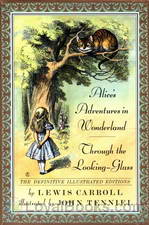 Alice's Adventures in Wonderland
An acclaimed children’s classic depicting the odd, but riveting journeys of the curious Alice as she explores the surreal world of Wonderland. Written by Charles Lutwidge Dodgson or better known under his pseudonym Lewis Caroll, this episodic novel is assembled in twelve chapters each containing a prominent adventure. The departure from logic and its embracement of pure imagination is what makes Alice’s Adventures in Wonderland a model for fantasy novels and a timeless classic. The novel begins when the self-aware young Alice, who grows bored of sitting by the river with her sister, and spots a peculiar looking rabbit, dressed in a waistcoat... | |
 Alice's Adventures Underground
This is the handwritten book that Carroll wrote for private use before being urged to develop it later into Alice in Wonderland. It was generously illustrated by Carroll and meant to entertain his family and friends. When a sick child in a hospital enjoyed it so much, the mother wrote him saying it had distracted her for a bit from her pain and led eventually to Carroll expanding the story. The Reverend Charles Lutwidge Dodgson and the Reverend Robinson Duckworth rowed in a boat, on 4 July 1862,[12]... | |