 |
Books Should Be Free Loyal Books Free Public Domain Audiobooks & eBook Downloads |
|
|
|
Books Should Be Free Loyal Books Free Public Domain Audiobooks & eBook Downloads |
|
Philosophy Books |
|---|
|
Book type:
Sort by:
View by:
|
By: John Masefield (1878-1967) | |
|---|---|
 Selected Public Domain Poems
Maritime and metaphysical verse by John Masefield, English poet and author, Poet Laureate of the United Kingdom from 1930 until his death. | |
By: John McGovern (1850-1917) | |
|---|---|
 The Golden Censer Or, the duties of to-day, the hopes of the future
| |
By: John McTaggart (1866-1925) | |
|---|---|
 The Unreality of Time
John McTaggart (1866-1925) was a British metaphysician and philosophical idealist. In this famous article for the periodical Mind, he introduced the notion of the A, B and C series, which was to become a leading theory in explaining the nature of time. | |
By: John Morley (1838-1923) | |
|---|---|
|
Diderot and the Encyclopædists (Vol 1 of 2)
| |
|
Diderot and the Encyclopædists Volume II.
| |
By: John Ruskin (1819-1900) | |
|---|---|
 Lectures on Landscape
A series of lectures on landscape painting delivered at Oxford in 1871, by artist, critic, and social commentator, John Ruskin. | |
 Unto this Last: Four Essays on the First Principles of Political Economy
John Ruskin (1819 – 1900) is best known for his work as an art critic and social critic, but is remembered as an author, poet and artist as well. Unto This Last is an important work of political economic though that influenced Gandhi, among others. (Hugh McGuire/Wikipedia) | |
|
The Ethics of the Dust
| |
By: John S. C. Abbott (1805-1877) | |
|---|---|
|
The Child at Home The Principles of Filial Duty, Familiarly Illustrated
| |
By: John Stuart Mill (1806-1873) | |
|---|---|
 On Liberty
Published in 1859, On Liberty is a libertarian philosophical work by English philosopher John Stuart Mill that endorses his view on the importance of individuality for the constant progression and improvement of society. The work also supports economic and moral freedom, and openly criticizes the influence of social authority that in one way or another imposes a predefined set of acceptable attitudes and opinions. Highlighting issues including the incongruity between authority and liberty, the oppressive... | |
 Essays on Some Unsettled Questions of Political Economy
This is Mill’s first work on economics. It foreshadows his Political Economy which was the standard Anglo-American Economics textbook of the late 19th and early 20th centuries. Mill’s economic theory moved from free market capitalism, to government intervention within the precepts of Utilitarianism, and finally to Socialism. | |
 Utilitarianism
John Stuart Mill’s book Utilitarianism is one of the most influential and widely-read philosophical defenses of utilitarianism in ethics. The essay first appeared as a series of three articles published in Fraser’s Magazine in 1861; the articles were collected and reprinted as a single book in 1863. It went through four editions during Mill’s lifetime with minor additions and revisions. Although Mill includes discussions of utilitarian ethical principles in other works such as On Liberty and The Subjection of Women, Utilitarianism contains Mill’s only major discussion of the fundamental grounds for utilitarian ethical theory. | |
 The Subjection of Women
The Subjection of Women is the title of an essay written by John Stuart Mill in 1869, possibly jointly with his wife Harriet Taylor Mill, stating an argument in favor of equality between the sexes. It offers both detailed argumentation and passionate eloquence in opposition to the social and legal inequalities commonly imposed upon women by a patriarchal culture. Just as in “On Liberty,” Mill defends the emancipation of women on utilitarian grounds, convinced that the moral and intellectual advancement of women would result in greater happiness for everybody. | |
|
Considerations on Representative Government
Mill's volume was published in 1861 as an argument favoring this form of governance. Mill covers what forms of government work best, including when representative government is applicable and when not. He details appropriate functions of representative bodies and warns of problems to avoid. He distinguishes between true and false democracy. Other areas covered include how voting is carried out, the role of a second chamber in Parliament, and how an executive branch might function. | |
|
Auguste Comte and Positivism
Part 1 lays out the framework for Positivism as originated in France by Auguste Comte in his Cours de Philosophie Positive. Mill examines the tenets of Comte's movement and alerts us to defects. Part 2 concerns all Comte's writings except the Cours de Philosophie Positive. During Comte's later years he gave up reading newspapers and periodicals to keep his mind pure for higher study. He also became enamored of a certain woman who changed his view of life. Comte turned his philosophy into a religion, with morality the supreme guide. Mill finds that Comte learned to despise science and the intellect, instead substituting his frantic need for the regulation of change. | |
By: John Toland (1670-1722) | |
|---|---|
 Pantheisticon
Pantheisticon: or, the Form Of Celebrating the Socratic-Society. Divided into Three Parts. Which Contain, I. The Morals and Axioms of the Pantheists; or the Brotherhood. II. Their Deity and Philosophy. III. Their Liberty, and a Law, neither deceiving, nor to be deceived. To which is prefix’d a Discourse upon the Antient and Modern Societies of the Learned, as also upon the Infinite and Eternal Universe. And subjoined, a short dissertation upon a Two-fold Philosophy of the Pantheists, that is to be followed; together with an Idea of the best and most accomplished Man... | |
By: John Tulloch (1823-1886) | |
|---|---|
|
Pascal
| |
By: Jonathan Edwards (1703-1758) | |
|---|---|
|
Dissertation Concerning the Nature of True Virtue
Disproportionately remembered as a hellfire-and-brimstone Puritan preacher on the basis of the excessively-anthologized "Sinners in the Hands of an Angry God," Jonathan Edwards was a noted philosopher in the field of Aesthetics, or the metaphysics of Beauty. An examination even of his sermons reveals constant references to this philosophical preoccupation, his favorite word in many passages seeming to be "Sweetness," by which term he intended to convey a rich sense of Beauty. In "A Dissertation... | |
By: Joseph Butler (1692-1752) | |
|---|---|
|
Human Nature and Other Sermons
| |
By: Josephine Preston Peabody (1874-1922) | |
|---|---|
|
After Music
Josephine Preston Peabody was an American poet and dramatist. She was born in New York and educated at the Girls’ Latin School, Boston, and at Radcliffe College. | |
By: Julia M. Grundy (b. 1874) | |
|---|---|
|
Ten Days in the Light of Acca
This work is the story of a pilgrimage made over a hundred years ago by a group of American pilgrims. They were not headed for Canterbury, Rome or Jerusalem. Rather, they were headed for an historical but remote prison-city in a far corner of the Ottoman Empire. ‘Akká (Akko), now a city in Israel which attracts thousands of Bahá’í pilgrims each year, was but little thought of in that early period. It was originally the final place of exile and imprisonment for Bahá’u’lláh, a Persian nobleman who proclaimed that He was the Promised One of all religions and Messenger of God for this day and age... | |
By: Kahlil Gibran (1883-1931) | |
|---|---|
|
Madman: His Parables And Poems and The Forerunner: His Parables And Poems
Two short books by the Lebanese-American writer, poet, and mystic. Reflections on existence and life, purpose and meaning. His most famous work is The Prophet .The Madman, Part 1: Introduction; God; My Friend; The Scarecrow; The Sleep-Walkers; The Wise Dog; The Two Hermits; On Giving And Taking; The Seven Selves; War; The Fox; The Wise King; Ambition; The New Pleasure; The Other Language; The Pomegranate; The Two Cages; The Three Ants; The Grave Digger; On The Steps Of The Temple; The Blessed City... | |
By: Karl Marx | |
|---|---|
 Capital: A Critical Analysis of Capitalist Production
Karl Marx’s Capital: A Critical Analysis of Capitalist Production is a critical analysis of the political economy or the capitalist system. In this 3 volume work, he says that a capitalist economy can only survive by exploiting the working class. The concepts discussed in this book laid the foundations of the political doctrine that would later be known as communism. This book has three volumes, the first volume is Marx’s critical analysis of the capitalist mode of production and how it’s effects on poor people... | |
 Eleven Theses on Feuerbach
The “Theses on Feuerbach” are eleven short philosophical notes written by Karl Marx in 1845. They outline a critique of the ideas of Marx’s fellow Young Hegelian philosopher Ludwig Feuerbach. The theses form a basis for the activism emphasised by Marx’s work, and this short text is perhaps best know for its ending – a Eureka for revolutionary socialism. The theses were written in 1845, but not published until 1888 (five years after Marx’s death), with slight modifications by Friedrich Engels. The original text was published in 1924. This translation is based on the 1888 version. | |
By: L. W. Rogers (1859-1953) | |
|---|---|
|
Elementary Theosophy
This book provides the basics of Theosophy and perhaps the beginning of a life long journey. Theosophy comes from the ancient wisdom that man and nature are as inseparable from the universe as the universe is inseparable from man and nature. It is a science and a philosophy, not a religion which depends on (dogma) faith. Knowledge gained through the study of Theosophy comes from the understanding of natural laws and harmony of the universe. Rogers shows us why we cannot separate ourselves from God (universe); the evolution of the soul; rebirth after physical death; why we don’t remember past lives and much more... | |
By: Lafcadio Hearn (1850-1904) | |
|---|---|
|
Exotics and Retrospectives
Lafcadio Hearn, born 1850 in Greece, went to Japan when he was 40 years old and became a Japanese citizen only 6 years later. His writings about Japan from the beginning of the Meiji era, when the country was just opening to the West, remain among the most important explanations of Japanese culture. This book contains in the first part, "Exotics", his observations of and personal insights into Japan. For example, Fuji no Yama tells about him climbing the highest mountain in Japan; and A Question in the Zen Texts, Literature of the Dead, and Of Moon Desire try to explain Buddhist teachings... | |
By: Lao Tzu | |
|---|---|
|
Laotzu's Tao and Wu Wei
The classic of the Way and of High Virtue is the Tao Teh Ching. Its author is generally held as a contemporary of Confucius, Lao Tzu, or Laozi. The exact date of the book’s origin is disputed. The book is divided into two parts, the Upper Part and the Lower Part. The Upper Part consists of chapters 1-37, and each chapter begins with the word “Tao,” or the Way. The Lower Part consists of chapters 38-81, and each chapter begins with the words “Shang Teh,” or High Virtue. This 1919 edition names the Lower Part as the Wu Wei, or translated variously as “not doing,” “non-ado,” or “non-assertion... | |
By: Laozi | |
|---|---|
 The Tao Teh King, or the Tao and its Characteristics
Written in classical Chinese some time during the sixth century BC, The Tao Teh King or The Tao and its Characteristics is a classical Chinese text that is one of the important keystones in understanding the thought systems of Asia. Though no clear records exist, it is traditionally thought to have been the work of the sage Lao Tzu, the founder of classical Taoism. He is reputed to have been a contemporary of Confucius, though this is also shrouded in mystery. However, many succeeding emperors and dynasties have claimed that he lived in their eras... | |
By: Lawrence Thomas Cole (1869-) | |
|---|---|
|
The Basis of Early Christian Theism
| |
By: Leo Tolstoy (1828-1910) | |
|---|---|
 The Kingdom of God is within you
The title of the book comes from Luke 17:21. It is a non-fiction work of the famous Russian author Leo Tolstoy. He wrote it after many years of reflexion on Christianity and Jesus. Many subjects are present such as wars, non-violence, misunderstanding by believers of the faith, etc. | |
 Bethink Yourselves!
As Russia goes to war against Japan, Tolstoy urges those at all levels of society, from the Tsar down to the common soldier, to consider their actions in the light of Christ's teaching. "However strange this may appear, the most effective and certain deliverance of men from all the calamities which they inflict upon themselves and from the most dreadful of all—war—is attainable, not by any external general measures, but merely by that simple appeal to the consciousness of each separate man which, nineteen hundred years ago, was proposed by Jesus—that every man bethink himself, and ask himself, who is he, why he lives, and what he should and should not do... | |
|
My Confession
"My Confession" is a brief autobiographical story of Leo Tolstoy's struggle with a mid-life existential crisis of melancholia. It describes his search for answers to the profound questions "What will come of my life?" and "What is the meaning of life?", without answers to which life, for him, had become "impossible." Tolstoy reflects on the arc of his philosophical life until then: his childhood abandonment of his Russian orthodox faith; his mastery of strength, will, power, and reason; and how, after he had achieved tremendous financial success and social status, life to him seemed meaningless... | |
By: Leslie Stephen (1832-1904) | |
|---|---|
|
The English Utilitarians
| |
|
Social Rights and Duties, Volume I (of 2) Addresses to Ethical Societies
| |
By: Lewis Carroll (1832-1898) | |
|---|---|
|
Symbolic Logic
| |
|
The Game of Logic
| |
By: Lieh Tzu | |
|---|---|
 Yang Chu's Garden of Pleasure
At the Court of Liang at the period of Yang Chu, about 300 B.C., the philosophers were treated as guests of the reigning king, who reserved for them lodging and maintenance, and encouraged all who had any pretence to the pursuit of truth and wisdom. Whether or not Yang Chu was actually a native of the Wei State, or whether he came there drawn by the attraction of a critical and unrivalled audience, it is at least certain that he settled there as small proprietor, probably in the reign of King Hwei, and continued there till his death, about 250 B... | |
By: Lucius Annaeus Seneca | |
|---|---|
|
Of the Shortness of Life
De Brevitate Vitae ("Of the Shortness of Life") is a moral essay written by Seneca the Younger, a Roman Stoic philosopher, to his friend Paulinus. The philosopher brings up many Stoic principles on the nature of time, namely that men waste much of it in meaningless pursuits. According to the essay, nature gives man enough time to do what is really important and the individual must allot it properly. In general, time can be best used in the study of philosophy, according to Seneca. | |
By: Ludwig Feuerbach (1804-1872) | |
|---|---|
 The Essence of Christianity
Taking issue with Hegel’s sense that God, as Logos, is somehow central to all that is, Feuerbach explores his own notion that Christianity, as religion, grew quite naturally from ordinary human observation. Only upon deeper, systematic reflection did people postulate a divine source–God. Religious teaching which loses sight of its own essential rootedness in human experience runs the risk becoming overly abstract, disconnected even, from realities which shape humanity and which impart meaning and dignity to life... | |
By: Ludwig Wittgenstein (1889-1951) | |
|---|---|
 Tractatus Logico-Philosophicus
Tractatus Logico-Philosophicus is the only book-length philosophical work published by the Austrian philosopher Ludwig Wittgenstein during his lifetime. He wrote it as a soldier and a prisoner of war during World War I. The slim volume (fewer than eighty pages) comprises a system of short statements, numbered 1, 1.1, 1.11, 1.12, etc., through to 7, intended to be such that 1.1 is a comment on or elaboration of 1, 1.11 and 1.12 comments on 1.1, and so forth. It is an ambitious project to identify the relationship between language and reality and to define the limits of science. | |
By: Lysander Spooner | |
|---|---|
 Essay on the Trial by Jury
FOR more than six hundred years that is, since Magna Carta, in 1215 there has been no clearer principle of English or American constitutional law, than that, in criminal cases, it is not only the right and duty of juries to judge what are the facts, what is the law, and what was the moral intent of the accused; but that it is also their right, and their primary and paramount duty, to judge of the justice of the law, and to hold all laws invalid, that are, in their opinion, unjust or oppressive, and all persons guiltless in violating, or resisting the execution of, such laws... | |
 Vices Are Not Crimes
Lysander Spooner was an American individualist anarchist, entrepreneur, political philosopher, abolitionist, supporter of the labour movement, and legal theorist of the nineteenth century. Here he gives his views on the role of Governments in the private lives of their citizens | |
By: M. M. Mangasarian (1859-1943) | |
|---|---|
 The Truth About Jesus. Is He a Myth?
The following work offers in book form the series of studies on the question of the historicity of Jesus, presented from time to time before the Independent Religious Society in Orchestra Hall, Chicago, 1909. No effort has been made to change the manner of the spoken, into the more regular form of the written, word. | |
By: Mabel Anne McKee (1886-) | |
|---|---|
|
The Heart of the Rose
| |
By: Marcus Aurelius (121-180) | |
|---|---|
 Meditations
Marcus Aurelius was a Roman Emperor and philosopher who wrote Meditations; insights which were considered to give the meaning of life. The book was not written with the intent to be published. It offers a noteworthy chain of challenging situations which are a reflection on spirituality and enumerate the struggle to understand oneself and one's role in the universe. Written in the style of a journal, Meditations emphasizes that life in this world is short. Aurelius was a stoic philosopher who had influenced the thoughts of many leaders in his time... | |
By: Marcus Tullius Cicero (106-43 BC) | |
|---|---|
 On the Laws
De Legibus (On the Laws) is a philosophical dialogue between: Cicero's friend Titus Pomponius Atticus; Cicero's brother Quintus; and Cicero himself. The dialogue is written in the style of Plato who was greatly revered by Cicero. De Legibus forms a continuation of Cicero's own work De re Publica (On the Commonwealth or On the Republic) and is also a response to Plato's work Νόμοι (Laws). It is unknown how many books the work originally contained but several complete books have been lost. Cicero's... | |
|
Academica
| |
|
The Academic Questions, Treatise De Finibus, and Tusculan Disputations, of M.T. Cicero, With a Sketch of the Greek Philosophers Mentioned by Cicero
| |
|
Tusculan Disputations
Tusculan Disputations (Latin: TUSCULANARUM DISPUTATIONUM) is divided into five books which discuss death, pain, grief, perturbations and virtue. At issue is whether wise people can always be happy regardless of the apparent evil that fortune throws in their way. Andrew Peabody says the A. and M. in the text may stand for Auditor, Adolescens, Atticus or Aulus and Marcus or Magister. Written by Marcus Tullius Cicero. Translated by Charles Duke Yonge. | |
By: Margaret Slattery | |
|---|---|
|
The Girl and Her Religion
| |
By: Marguerite Bernard and Edith Serrell | |
|---|---|
 Deer Godchild
A young New-Yorker of twelve heard an appeal for the Fatherless Children of France and his heart was touched. He had no money, but he resolved to give his spare time and his utmost energy to support a "kid in France." The French child needed ten cents worth of extra food each day, in order to grow up with strength and courage. The little American godfather earned those ten cents; he sold newspapers at the subway entrance, after school hours, and undertook an amazing variety of more or less lucrative odd jobs... | |
By: Maria Montessori (1870-1952) | |
|---|---|
 The Montessori Method
In the early 1900’s Dr. Maria Montessori began to reform educational methods with her work the ‘Case dei Bambini’ in Rome, Italy. Montessori began her work by developing methods to educate mentally retarded children, the method she developed was used with several children who at age eight took the state examinations in reading and writing, the children passed with above average scores. Because of this success (which is known as the ‘first Montessori Miracle’) Dr. Montessori was asked to open a school for children in Rome which she did... | |
By: Martin Luther (1483-1546) | |
|---|---|
|
Martin Luther's 95 Theses
| |
By: Mary Everest Boole (1832-1916) | |
|---|---|
 Philosophy and Fun of Algebra
Mary Everest Boole (1832-1916) was born Mary Everest in England and spent her early years in France. She married mathematician George Boole. She was the author of several works on teaching and teaching mathematics in particular. This short book, Philosophy and Fun of Algebra, is meant to be read by children and introduces algebra and logic. She uses the word “algebra” broadly, defining it as a “method of solving problems by honest confession of one’s ignorance”. Using this definition, Boole introduces, in a conversational manner, the concepts of logic and algebra, illustrating these concepts with stories and anecdotes, often from biblical sources... | |
By: Mary Greer Conklin | |
|---|---|
|
Conversation What to Say and How to Say it
| |
By: Mary Mills Patrick (1850-1940) | |
|---|---|
|
Sextus Empiricus and Greek Scepticism
| |
By: Mary Wollstonecraft (1759-1797) | |
|---|---|
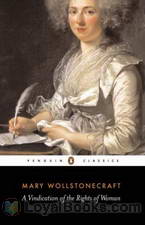 A Vindication of the Rights of Woman
Regarded as the one of the earliest examples of feminist philosophy, A Vindication of the Rights of Woman is written as a direct response to Charles Maurice de Talleyrand-Périgord, a French politician who delivered a report to the French National Assembly suggesting that women should only receive domestic education and additionally encourages women to stay clear of political affairs. In her treatise, Wollstonecraft avidly criticizes this inadequate perception of women as an inferior sex and attacks social inequality, while also arguing for women’s rights in the hope of redefining their position both in society and in marriage... | |
By: Mary Wood-Allen (1841-1908) | |
|---|---|
|
What a Young Woman Ought to Know
| |
|
Almost A Man
| |
By: Maud C. Cooke | |
|---|---|
|
Social Life or, The Manners and Customs of Polite Society
| |